


 Stock Futures Dip as Investors Await Key Payrolls Data
  Morgan Stanley Predicts $10 Trillion RWA Market by 2030
  Dogecoin Price Rises as Bitwise Plans DOGE ETF Closure
  BlackRock’s Rick Rieder Favors Bonds Over Stocks as Treasury Yields Surge
  Visa Wins China Approval to Prepare Domestic Payments Expansion
  BOJ Signals Faster Rate Hikes as Inflation Risks Grow
  Trump’s "Shock and Awe" Agenda: Executive Orders from Day One
  NEAR Price Surges 11% as Trading Volume Doubles
  Global Markets React to Strong U.S. Jobs Data and Rising Yields
  Bank of America Posts Strong Q4 2024 Results, Shares Rise
  European Stocks Rally on Chinese Growth and Mining Merger Speculation
  Bank of America Predicts Yen Rebound as USD/JPY Faces Risks
  RBA Hikes Interest Rate to 4.60% as Inflation Risks Rise
  Oil Prices Dip Slightly Amid Focus on Russian Sanctions and U.S. Inflation Data
  RBA Set for September Rate Hike as Inflation Stays High
  UBS Predicts Potential Fed Rate Cut Amid Strong US Economic Data
  RBI Uses $10 Billion Currency Swaps to Drain Excess Rupee Liquidity


 Add as a preferred source on Google
Although the Yen appears under pressure momentarily as BoJ caps nominal yields and risk sentiment holds up, but the move in relative real yields between Japan and the US represents a clear case for a weaker yen. The risk is for risk sentiment to change, thus the resilience of the risk mood bears watching because it is the key to the yen's continued weakness.
It has fallen by over 7% against the dollar since the election, more than any other Asian currency. A steady move higher in US yields is not expected to trigger a durable deterioration in risk sentiment for a while.
In addition, the BoJ’s strategy of capping nominal yields is paying dividends, as any pickup in domestic inflation expectations drives Japanese real yields down. The USDJPY, therefore, has scope to rally considerably further. We look for the USDJPY to reach 120 by September.
The dollar is unlikely to strengthen due to a flight-to-quality but would be boosted by higher US long yields being lifted by a sharp repricing of US inflation expectations.
Shorting the costly vols to trade a gradual move uncertainty is not going to lift volatility until the environment turns risk-off. So far, the Trump victory has not triggered such a shift. On top of that, the USDJPY uptrend is likely to slow down after the initial topside acceleration in autumn 2016.
As the suspicion, the Japanese central bank’s yield control transferred rates volatility towards FX volatility. But yen depreciation should now be more gradual. The recent fast upside lifted the 6m implied volatility to its highest level since 2014.
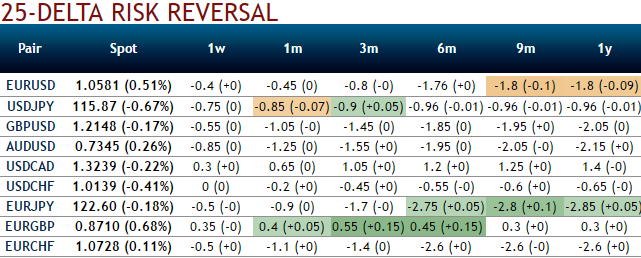
USDJPY 1m risk reversals and 2m IV skews are evidencing mounting hedging interests for downside risks (while articulating).
While the 2m realized volatility peaked at 18, it is already retracing much lower. With no risk-off shift in sight, and vega volatility still having to adjust to short-term dynamics, a short volatility structure makes sense.
Accordingly, a trade on “buy right-and-hold tight” logic is designed so as to match volatility regimes. It states the volatility but should suffer from initial negative convexity.







