


 Goldman Sachs Flags 3 Key Risks Ahead of Europe’s Earnings Season
  State of emergency in Crimea as Ukraine focuses pressure on ‘jewel in Putin’s crown’
  Vietnam’s population hit the 100 million milestone. Where’s it headed?
  Trump has made more than $1 billion from crypto in a year. How?
  Smartphones are helping filmmakers tell the stories the movie industry overlooks
  Bank of America Upgrades T-Mobile to Buy, Says LEO Satellite Fears Are Overdone
  JPMorgan Cuts Gold Price Forecast, Sees Bullion Reaching $4,500 by End of 2026
  In a rebuke to Trump, the Supreme Court rules that birthright citizenship is the law of the land
  Alcohol is one of the most dangerous drugs, yet its presence is ubiquitous in social settings and celebrations


 - EconoTimes)


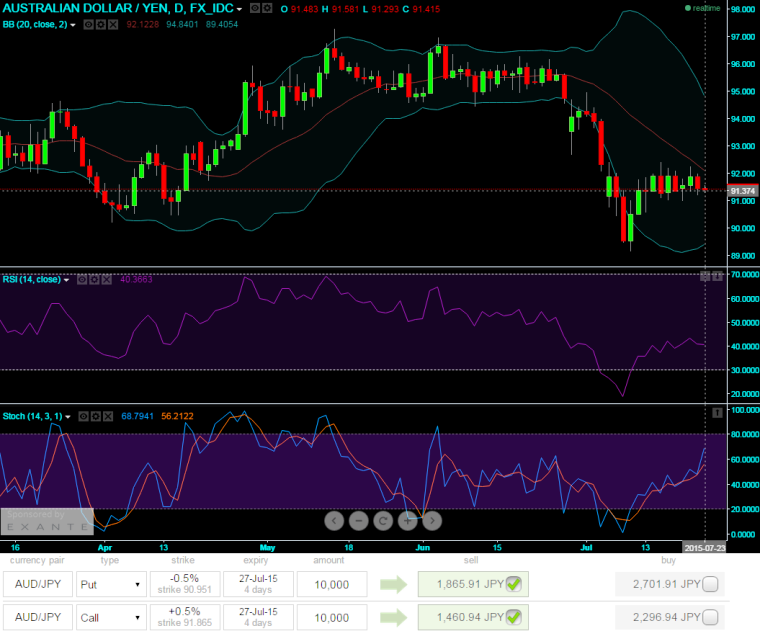
On daily charts we observed from last fortnight or so the pair did not break on a closing basis the range of 91.309 on downside and 91.915 on upside. Technically speaking the leading oscillator RSI (14) has been stagnant but converging according to the price fluctuations.
Rationale: There are no significant market drivers for both currencies until end of this week that propel the pair to any extreme directions.
Hence, we think the price to remain in this bandwidth; bulls make profits from uptrend and so does the bears in downswings. But this is how successful traders can get benefitted from even sideway trends.
So our recommendation contemplating current fundamental as well as technical reasoning would be Shorting 4D (-0.5%) Out-Of-The-Money put and simultaneously sell 4D (0+5%) Out-Of-The-Money call option for a net credit.
There would be 2 break-evens points for the short strangle execution as shown below,
Upper Breakeven Point = Exercise Price of Call + Premium Received
Lower Breakeven Point = Exercise Price of Put - Premium Received
Highest returns for this position is achievable only when AUDJPY exchange price is ticking between the strike prices of the options sold at maturity. At this price, both options expire worthless and the options trader gets to keep the entire initial credit taken as profit.

- News

- Economy

- Central Banks
- Investing
- Research
- Roundups
- Digital Currency
- Insights
- Technical Analysis
- Technology
- Business
- Law
- Health
- Nature
- Fintech
- Science
- Topic
- Opinions
- ©Econometrics LLC . All Rights Reserved.
FxWirePro: Shorting AUD/JPY strangles best suitable for range bound trend (91.309-91.915)
Thursday, July 23, 2015 6:17 AM UTC
Editor's Picks



- Market Data
Most Popular




