


 US Gas Market Poised for Supercycle: Bernstein Analysts
  Trump’s "Shock and Awe" Agenda: Executive Orders from Day One
  Indonesia Surprises Markets with Interest Rate Cut Amid Currency Pressure
  Stock Futures Dip as Investors Await Key Payrolls Data
  Mexico's Undervalued Equity Market Offers Long-Term Investment Potential
  Oil Prices Dip Slightly Amid Focus on Russian Sanctions and U.S. Inflation Data
  U.S. Treasury Yields Expected to Decline Amid Cooling Economic Pressures
  Bank of America Posts Strong Q4 2024 Results, Shares Rise
  European Stocks Rally on Chinese Growth and Mining Merger Speculation
  UBS Predicts Potential Fed Rate Cut Amid Strong US Economic Data
  Gold Prices Fall Amid Rate Jitters; Copper Steady as China Stimulus Eyed
  S&P 500 Relies on Tech for Growth in Q4 2024, Says Barclays
  US Futures Rise as Investors Eye Earnings, Inflation Data, and Wildfire Impacts
  Geopolitical Shocks That Could Reshape Financial Markets in 2025
  2025 Market Outlook: Key January Events to Watch
  Energy Sector Outlook 2025: AI's Role and Market Dynamics
  Goldman Predicts 50% Odds of 10% U.S. Tariff on Copper by Q1 Close


 likely to keep peso vulnerable, IV skews and valuations substantiate - EconoTimes)


Mexican peso (MXN) could be under pressure by the balance of payments dynamics in the medium-run. While the business sentiment continues to be near its weakest levels, whereas consumer sentiment remains resilient, backed by president AMLO’s strong popularity and minimum wage increases.
While this bodes once again poorly for investment, such dynamics could also have a negative impact on Mexico’s trade balance: manufacturing exports could stay weak, particularly as manufacturing PMI weakened once more in February (last) and new orders dropped.
The current valuations seem rich while foreign positions seem already short USD. MXN continues to trade on the rich-side relative to our BEER FV models, based on productivity and policy rate differentials, terms of trade and basic balance.
At the same time, in the near-term, technicals continue to bode poorly for MXN, particularly given heavy positions: long MXN positions via IMM contracts are already at their multi-year highs according to CFTC data.
JP Morgan team expects 2019 GDP growth at 1.5% and limited monetary policy rate changes this year (they expect Banxico to remain on hold through 2019), we suspect that portfolio inflows are likely to moderate ahead, limiting MXN’s main source of support this year.
While the weak growth, domestic political risks and growing concerns about the financial situation of the state-owned energy supplier and thus about a possible deterioration in public finances are likely to weigh on the peso in the coming months. But we do not expect an excessive depreciation as long as there is no external shock. Additionally, the negotiated USMCA deal should be ratified by the respective parliaments this year, which would remove a major uncertainty factor from last year.
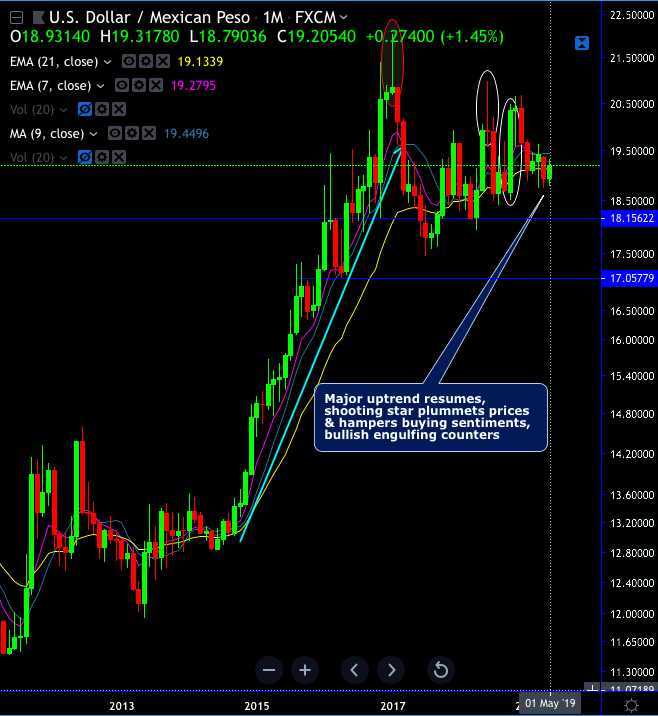
Technically, USDMXN major uptrend remains intact despite some minor corrections (refer above technical chart). We maintain MXN projections of 20.25 for end- 2019 and our long USD recommendations in options. The peso’s high carry is likely the reason for MXN’s outperformance this year among EMFX peers. Yet, extended MXN longs positions, BoP weakness, political uncertainty and some fiscal deterioration in our view make MXN more likely to weaken for the rest of the year.
Of late, MXN seemed to be extending recovery threatening upper bound of the recent range.
But please be noted that the 3m USDMXN implied volatility skews signal continued upside risks (refer above nutshell showing IV skews). The previous massive sell-off of Mexican peso caused a vol surface dislocation, nudging skews to the highest since the 2016 US Presidential elections. Delta hedged 1*1.5 ratio call spreads exploit the dislocation while also having historically offered a superb performance. +1Y/-3M calendars of risk reversals take advantage of the lagging back-end vs front-end implied skews, spot reference: 19.2050 levels. Courtesy: JPM, Sentry & Tradingview.com
Currency Strength Index: FxWirePro's hourly USD spot index was at -26 (mildly bearish) while articulating at (12:38 GMT).
For more details on the index, please refer below weblink: http://www.fxwirepro.com/currencyindex







