


 Oil Prices Dip Slightly Amid Focus on Russian Sanctions and U.S. Inflation Data
  U.S. Banks Report Strong Q4 Profits Amid Investment Banking Surge
  Bank Regulation Rollbacks in the U.S. and UK Could Increase Financial Risks, Study Warns
  Today’s space race could turn fatal if we don’t agree on new rules
  U.S. Stocks vs. Bonds: Are Diverging Valuations Signaling a Shift?
  US Gas Market Poised for Supercycle: Bernstein Analysts
  Fed May Resume Rate Hikes: BofA Analysts Outline Key Scenarios
  Gold Prices Fall Amid Rate Jitters; Copper Steady as China Stimulus Eyed
  Trump’s "Shock and Awe" Agenda: Executive Orders from Day One
  2025 Market Outlook: Key January Events to Watch
  Trump’s Iran Strategy: What Has Been Achieved After Three Months of Conflict?
  Moody's Upgrades Argentina's Credit Rating Amid Economic Reforms
  Goldman Predicts 50% Odds of 10% U.S. Tariff on Copper by Q1 Close
  UBS Predicts Potential Fed Rate Cut Amid Strong US Economic Data


The British economy advanced 0.5 pct on quarter in the three months to September of 2016, slowing from a 0.7 pct expansion in the previous period and in line with the preliminary estimate. Net external demand was the main driver of growth, while household expenditure and fixed investment rose at a slower pace.
But GDP forecast for 2017 has been revised up to 1.0% and remove our call of a rate cut early next year. Rather, we expect the BoE to remain on hold over the forecast horizon.
We also highlight that trend growth has decreased in recent years to about 1.5% today. Brexit, if anything, poses downside risks to this estimate.
Inflation and retail sales data released this week came in on the strong side, while the labor market report showed that employment fell and claimants increased.
The discounted gloomy UK outlook both prevents a new bold depreciation and a much stronger currency. The technical picture suggests a new turbulence and bearish pressures.
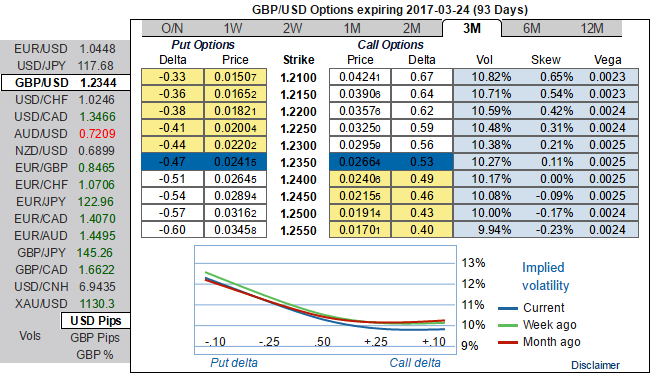
Owing to the above fundamental factors, GBP vols and risk reversals have been unchanged but to remain negative flashes to mitigate bearish risks in long run, while IV skews are also bidding OTM put strike which is line with the risk reversal indications.







