


 Goldman Sachs Says China Competition Weighs More on EU Growth Than Trade Deficit
  Goldman AM Sees Strong Buyout Opportunities in Japan, South Korea and Australia
  Trump has made more than $1 billion from crypto in a year. How?
  In a rebuke to Trump, the Supreme Court rules that birthright citizenship is the law of the land
  Smartphones are helping filmmakers tell the stories the movie industry overlooks
  Gold Surges Past $4150 on Dovish Fed Signals and Weak Jobs Data; Bullish Outlook Prevails
  Goldman Sachs Raises USD/JPY Forecast, Sees Yen Weakness Persist Through 2027
  Gold Pulls Back After Hitting $4,180 as Geopolitical Risk Sends Crude Higher


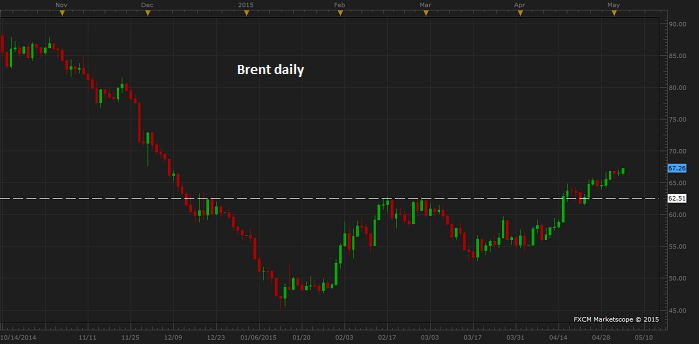
Crude oil benchmarks WTI and Brent both has set an important bottom this year. Brent is up 16% this year so far, while WTI is up 11.5%. In recent times both are struggling to gain further ground.
Brent is currently trading at $67.4/barrel, while WTI is trading at $60.1/barrel.
Traders should keep check of the following fundamental drivers to gauge further move in prices.
US imports and Chinese demand -
A drop in US imports led to Saudi Arabia and North African crude in search of buyers. That finally led to massive price war between oil producing countries to increase customer base in Europe and Asia. Several Gulf countries including Saudi Arabia, Iran has sent convoys to China to assure their presence in Chinese market through diplomatic ties. China now consumes about little more than 10% of global oil production and there talks of massive built up of Chinese strategic reserve.
Further reduction of US imports would cause havoc for Brent if Chinese demand fails to rise significantly.
Middle East tensions -
Iran so far hasn't been actively involved in Yemen conflict, where Saudi lead coalition bombing and backing of local militia causing havoc for Iran backed Houthi Rebels who remain in control. Yemen shares border with Strategic oil choke point of Bab el-Mandeb.
So far there no signs of the passage being under threat, however active involvement of Iran could led to chocking of cargos in another strategic oil point control by Iran, Strait of Hormuz. About 22 million barrels of crude passes through these two junction daily.
Dollar -
Since WTI is quoted in $/barrel, stronger dollar since last year has been producing headwinds for Brent. Weaker dollar like in recent would be price supportive of Brent.
Middle East and Russian production -
As of now OPEC cooperation stands broken, with countries producing crude at record pace more than 30 million barrels/day. Platts' ship data indicate that supply still remains at large and Iran nuclear deal could free up exports further. Iraq produced record crude in April, more than 3 million barrels/day. Russia is also producing crude at record pace, close to 10.6 million barrels/day and won't give in to cooperation given its ongoing conflict with western countries.
Iran has already increased exports to more than million barrel/day, however it could rise further and faster should a final accord gets reached over nuclear deal in June.







