


 Trump Says Iran Talks Halted as Strait of Hormuz Dispute Fuels Oil Concerns
  UK Wage Growth Holds at 3.5% as Unemployment Rises
  Colombia Earthquake Losses Estimated at $9.58 Billion as Reconstruction Challenge Mounts
  Canada Faces 50% U.S. Tariffs as Trade Tensions Threaten USMCA Talks
  US Dollar Holds Steady as Fed Rate Bets and Iran Tensions Drive Markets
  Switzerland Industrial Production Jumps 5.5% in Q2 2026
  Gold Prices Slide as Treasury Yields Surge, Fed Minutes in Focus
  Asian Stocks Slide as Chip Selloff and High Bond Yields Hit Markets
  UK Inflation Rises to 2.9% in July as Energy Costs Climb
  Asian Chip Stocks Plunge as Bond Yields Fuel AI Valuation Fears
  Oil Prices Rise as Iran-U.S. Tensions Threaten Strait of Hormuz Supply


 Add as a preferred source on Google
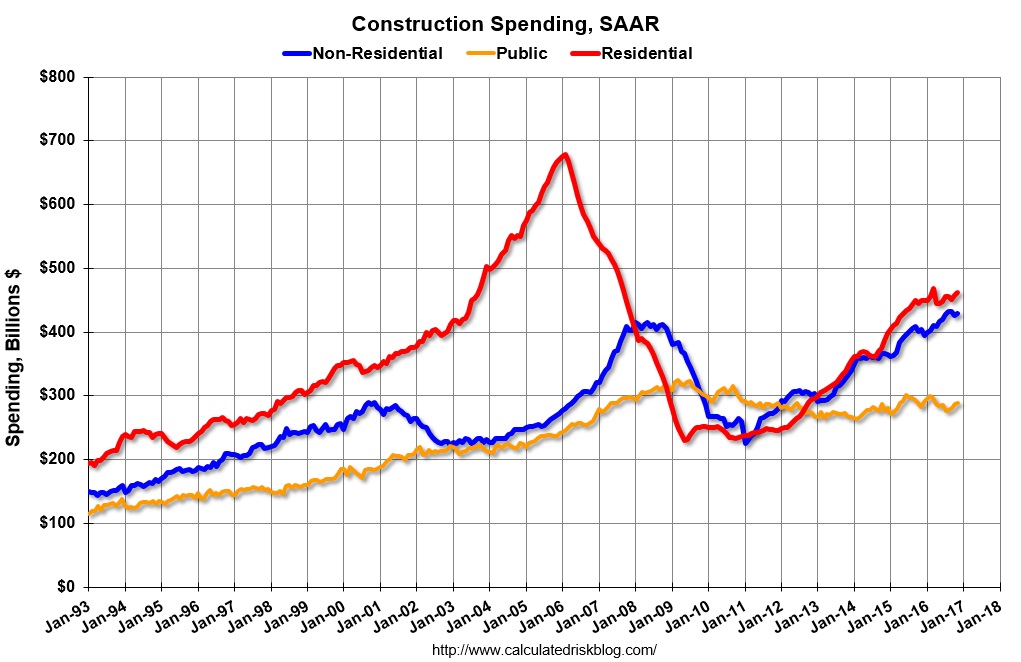
Earlier this week, US Census Bureau reported the November figure for construction spending and it showed that there was an increase in the month. The U.S. Census Bureau of the Department of Commerce announced that the construction spending during November 2016 was estimated at a seasonally adjusted annual rate of $1,182.1 billion, 0.9 percent above the revised October estimate of $1,171.4 billion. The November figure is 4.1 percent above the November 2015 estimate of $1,135.5 billion. During the first 11 months of this year, construction spending amounted to $1,070.9 billion, 4.4 percent above the $1,025.5 billion for the same period in 2015. Both private and public spending increased in November. In November, the estimated seasonally adjusted annual rate of public construction spending was $289.3 billion, 0.8 percent above the revised October estimate of $287.1 billion.
Despite a steady rise in construction spending since 2011, they remain well below the levels seen before the crisis. In 2006, the residential construction spending peaked just below $700 billion (annual rate) and now its stands just around $450 billion. Public construction spending peaked in 2009 above $300 billion but since then it has declined and remains stagnant. The newly elected President of the United States, Donald Trump has promised to ramp up the infrastructure spending and evidence of that would be found in the public construction spending component.
Chart courtesy – calculatedriskblog.com







