


 Silver Cracks Key 365-Day EMA for First Time Since Feb 2024; Bears Eye $50 on Rallies
  Goldman Sachs: US Dollar Likely to Stay Strong Despite Oil Price Retreat
  AI Memory Boom Sparks Global Chip Supply Crunch
  China’s AI Manufacturing Boom Masks Weak Consumer Economy, Citi Says
  Sell the Bounce": Gold Rally Stalls Near $4165 as Fed Hawks Slam the Door on Rate Cuts — Targets $4000/$3600
  Gold's 365-Day EMA Streak Since Oct 2023 Faces Its First Real Test at $3,980 — Break or Bounce to $4,140?
  How Donald Trump has changed the way diplomacy is done
  How AI prompting turned writerly description into an everyday skill
  Today’s space race could turn fatal if we don’t agree on new rules


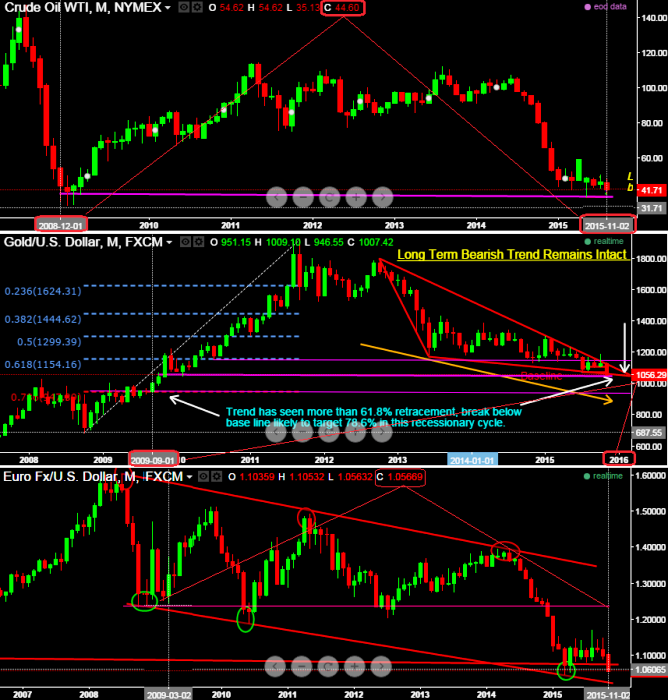
Since World War II, the average length of time between recessions is 5 to 6 years. With the current cycle clocking in at 81, it's natural to wonder if the next downturn is imminent.
Global inflation has begun to reflect recessionary levels (around 1% Y/Y change).
Global trade has collapsed as reflected by the 80% drop over the last 18 months.
Declining trend over various asset classes (Bullion, crude and equity indices); compare the current levels with 2008 when last recession took place (see technical charts).
Recessionary trends are appearing in overall US imports/exports.
China's economy appears to be turning recessionary, recent currency devaluation has been the evidence so as to protect their economy.
In Germany, Europe's strongest economy, exports fell 5.2% in August from the previous month, growth momentum for been in the recessionary mode.
Japan already seems to have entered into the recessionary phase; industrial output disappoints projections (1.4% versus forecasts 1.9%).
It seems that the slow growth in snail's pace is only a momentary result of the 2008 financial crisis is absurd, this is no room for complacency.
The latest data suggest growth is slowing in the United States, and it is already slow in Europe and Japan. A global economy near stall speed is one where the primary danger is recession.

- News

- Economy

- Central Banks
- Investing
- Research
- Roundups
- Digital Currency
- Insights
- Technical Analysis
- Technology
- Business
- Law
- Health
- Nature
- Fintech
- Science
- Topic
- Opinions
- ©Econometrics LLC . All Rights Reserved.
Flurry of reasons to ponder over global markets sensing recessionary phase
Monday, November 30, 2015 12:31 PM UTC
Editor's Picks



- Market Data
Most Popular




