


 Jefferies Names 6 Top India Stock Picks Across Key Sectors
  China’s robots can run faster than Usain Bolt – now they are being prepared for war
  ‘Buy now, pay later’ doesn’t feel like debt. For young people, that can be a big problem
  Goldman Sachs Forecasts Fed Rate Hike as Inflation Risks Rise
  AI is supercharging money scams – here’s what you can do to protect yourself
  Who should own the knowledge that underpins AI technology?
  Physicists zoom into the birth of cosmic rainstorms with new CERN study
  Big AI wants to slow down AI research. Is it a safety pause or a strategic retreat?


 Add as a preferred source on Google
FTX Creditor Payments Begin
FTX will begin paying its creditors starting February 18, 2025. The very first ones to be paid are those in the Bahamas with claims of less than $50,000. These "Convenience Class" creditors shall receive their full claim amount plus a 9% annual interest from November 11, 2022. Creditors may find that their payment has been applied "pending" in their account for up to 10 days before it's actually done. To make payments, BitGo, a crypto custody company, will assist. Other FTX creditors outside the Bahamas will receive their distributions starting March 4, 2025. The plan was allowed on October 2024, effective January 3, 2025. Claimants must verify their BitGo account information on the FTX Digital Claim Portal.
FTTUSD Market Trends
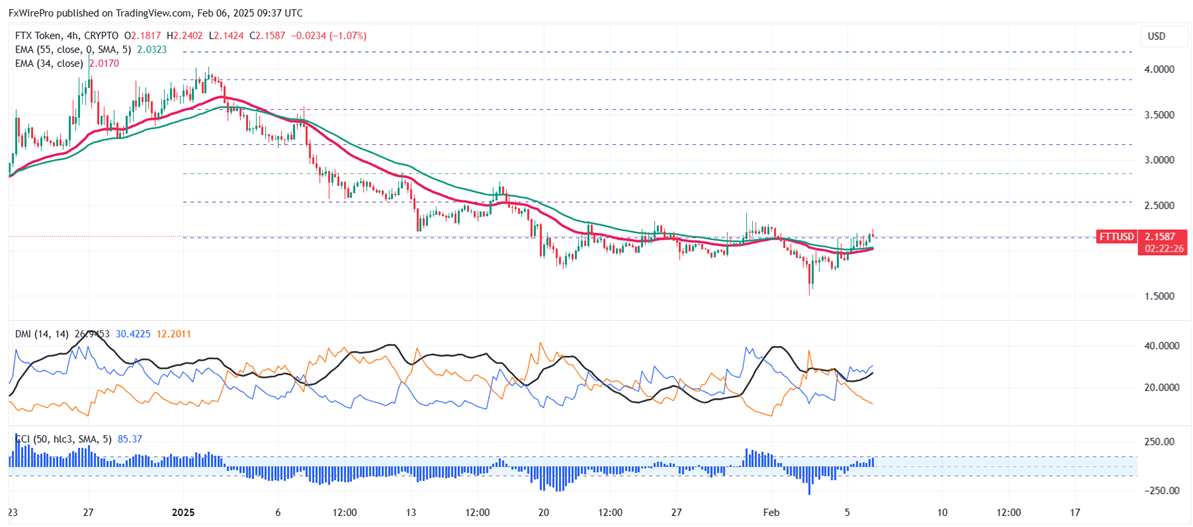
FTTUSD trades higher for the past one week. Any daily close above $4.35 confirms further bullishness. FTTUSD surged more than 45% after hitting a minor bottom of $1.50. The pair holds above the short-term (34 and 55 EMA) and below the long-term moving averages on the 4-hour chart. The bullish invalidation can happen if the pair closes below $1. On the lower side, the near-term support is $2; any close below will target $1.50$1. The pair's near-term resistance is around $2.50, and any breach above confirms minor bullishness. A jump to $3.17/$4.35 is possible. A surge past $4.35 will take it to $5/$6/8/8/10.
Recommended Investment Strategy
It is advisable to buy on dips around $2 with a stop-loss around $1.50 for a target price of $3.16/$4.30.







