


 In a rebuke to Trump, the Supreme Court rules that birthright citizenship is the law of the land
  State of emergency in Crimea as Ukraine focuses pressure on ‘jewel in Putin’s crown’
  Elon Musk is remaking the world, like Henry Ford before him – but more dangerously
  Goldman Sachs Flags 3 Key Risks Ahead of Europe’s Earnings Season
  Gold Pulls Back After Hitting $4,180 as Geopolitical Risk Sends Crude Higher
  Bernstein Names IAG, Ryanair as Top European Airline Stocks Ahead of Earnings
  AI can be a personal trainer in your pocket – but is it safe?
  USA at 250: the Black American struggle for life, liberty and the pursuit of happiness
  Smartphones are helping filmmakers tell the stories the movie industry overlooks
  Trump has made more than $1 billion from crypto in a year. How?


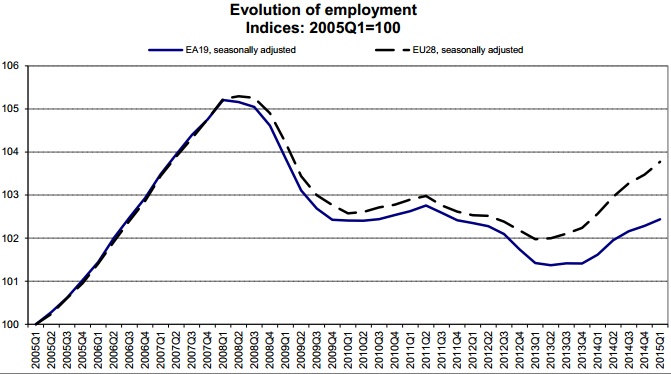
With European Central Bank (ECB) providing the necessary support, European Government and European investment banks should deploy policies, which would bring back Europeans back into jobs.
Inflation through monetary easing may not be the ideal form of inflation, which everyone is so looking forward to achieve. Weaker Euro is importing inflation, which is not ideal for an area where still more than one in every ten remains unemployed.
- According to latest report from Eurostat, employment rose only by 0.8% in the first quarter from a year ago and quarterly rise is pretty lacklustre at 0.1%.
- Some members in Euro zone still bleeding employment. Greece lost employment by another -0.8% in the first quarter and Malta lost by -0.4%.
- Two of Euro zone's biggest economies, Germany and France couldn't increase employment further. While German unemployment rate is low around 6.4%, for France it is still above 10%.
If European governments fail to tackle the unemployment level, situations like Syriza will keep appearing from time to time.
Moreover only bringing back people to payroll would ensure demand driven inflation in Euro zone.







