


 In a rebuke to Trump, the Supreme Court rules that birthright citizenship is the law of the land
  Goldman Sachs Says China Competition Weighs More on EU Growth Than Trade Deficit
  Gold Surges Past $4150 on Dovish Fed Signals and Weak Jobs Data; Bullish Outlook Prevails
  Goldman AM Sees Strong Buyout Opportunities in Japan, South Korea and Australia
  Bernstein Names IAG, Ryanair as Top European Airline Stocks Ahead of Earnings
  Citi Raises TSMC Price Target as AI Chip Demand Strengthens Growth Outlook
  Gold Pulls Back After Hitting $4,180 as Geopolitical Risk Sends Crude Higher
  Smartphones are helping filmmakers tell the stories the movie industry overlooks
  Goldman Sachs Raises USD/JPY Forecast, Sees Yen Weakness Persist Through 2027
  Vietnam’s population hit the 100 million milestone. Where’s it headed?


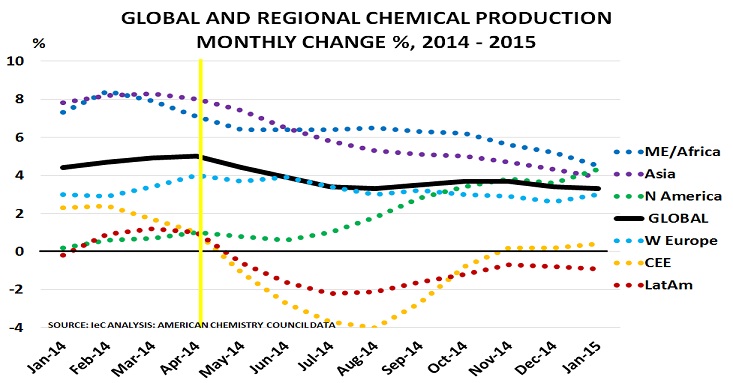
Changes in economy occurs first at micro levels (companies, production of goods), which then gets reflected in macro levels (GDP, inflation).
- In lot many ways, growth in chemical companies viz. production is a leading economic indicator and the current condition is expressed nicely in a chart from ICIS, a market intelligence provider in chemical and fertilizer industry.
- Global growth peaked in January 2014 to 5.1% have lagged since then and currently at 3.3%
- Growth in North America has increased significantly from 0.1% in January 2014 to more than 4% as of now. This reaffirms the return of growth in US.
- Growth in Middle East has slowed from 8% in February 2014 to 4.5% as of now.
- Growth in Asia slowed to 3.9% from its peak around 8% in early 2014.
- Growth has remained subdued across Euro zone though it shows some signs of recovery. In central and eastern Europe growth slumped to - 4% however started recovering since then.
- Latin America continues to experience negative growth.
Analogy -
- Global recovery would take longer despite strong US economy. Central banks are to keep monetary policies ultra-loose.
- However as situation improves across Euro zone and ECB vows to keep monetary policy loose, the equities might gain further.
- Diverging growth in Asia, Middle East and Latin America compared to US, might keep the dollar stronger against the currencies of these regions.







