


 Bill Gates Warns Governments Are Unprepared for AI Disruption
  Anthropic Eyes Second Straight Profitable Quarter Ahead of Potential IPO
  SpaceX Nasdaq 100 Weight Set to More Than Double
  BHP Port Hedland Wage Dispute Heads to Arbitration
  Trip.com Shares Rise as Q2 Earnings Beat Estimates
  Meta CEO Zuckerberg Backs Independent AI Safety Reviews Over Development Slowdown
  Nvidia Eyes $10 Billion Investment in Anthropic IPO
  OpenAI Rules Out 2026 IPO as Altman Prioritizes AI Safety
  Databricks to Invest $350 Million in Singapore AI Expansion
  American Airlines Eyes Capacity Cuts as High Fuel Prices Persist
  Cathie Wood Backs AI Slowdown as Safety Concerns Grow
  SK Hynix, Intel Discuss U.S. Memory Chip Production Deal
  Ares Names James Garforth Principal for Asia Direct Lending
  Rosenblatt Starts Nokia at Buy on AI Networking Growth
  Syngenta Files for Hong Kong IPO, Eyes $5 Billion Raise
  US Court Approves airBaltic Chapter 11 Restructuring


 Add as a preferred source on Google
Title of course:
The Design of Coffee: An Introduction to Chemical Engineering
What prompted the idea for the course?
In 2012, my colleague professor Tonya Kuhl and I were drinking coffee and brainstorming how to improve our senior-level laboratory course in chemical engineering. Tonya looked at her coffee and suggested, “How about we have the students reverse-engineer a Mr. Coffee drip brewer to see how it works?”
A light bulb went off in my head, and I said, “Why not make a whole course about coffee to introduce lots of students to chemical engineering?”
And that’s what we did. We developed The Design of Coffee as a freshman seminar for 18 students in 2013, and, since then, the course has grown to over 2,000 general education students per year at the University of California, Davis.
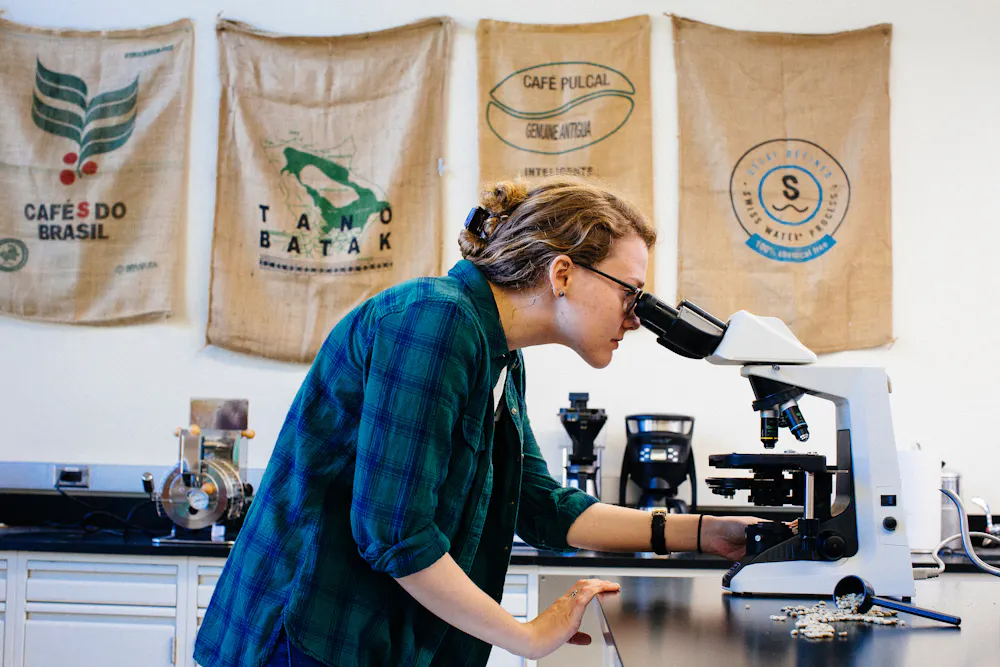
A student uses a microscope to look at coffee beans in The Design of Coffee lab. UC Davis
What does the course explore?
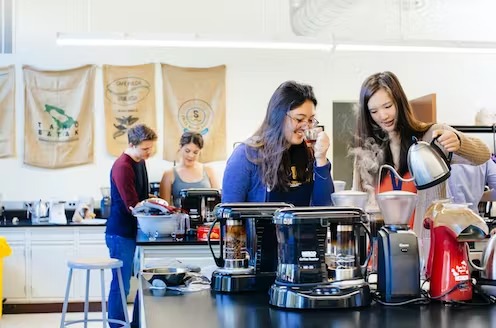
The course focus is hands-on experiments with roasting, brewing and tasting in our coffee lab.
For example, students measure the energy they use while roasting to illustrate the law of conservation of energy, they measure how the pH of the coffee changes after brewing to illustrate the kinetics of chemical reactions, and they measure how the total dissolved solids in the brewed coffee relates to time spent brewing to illustrate the principle of mass transfer.
The course culminates in an engineering design contest, where the students compete to make the best-tasting coffee using the least amount of energy. It’s a classic engineering optimization problem, but one that is broadly accessible – and tasty.
Why is this course relevant now?
Coffee plays a huge role in culture, diet and the U.S. and global economy. But historically, relatively little academic work has focused on coffee. There are entire academic programs on wine and beer at many major universities, but almost none on coffee.

Many students who don’t like coffee develop a taste for it over the course of the class. UC Davis
The Design of Coffee helps fill a huge unmet demand because students are eager to learn about the beverage that they already enjoy. Perhaps most surprisingly, many of our students enter the course professing to hate coffee, but by the end of the course they are roasting and brewing their own coffee beans at home.
What’s a critical lesson from the course?
Many students are shocked to learn that black coffee can have fruity, floral or sweet flavors without adding any sugar or syrups. The most important lesson from the course is that engineering is really a quantitative way to think about problem-solving.
For example, if the problem to solve is “make coffee taste sweet without adding sugar,” then an engineering approach provides you with a tool set to tackle that problem quantitatively and rigorously.
What materials does the course feature?
Tonya and I originally self-published our lab manual, The Design of Coffee: An Engineering Approach, to keep prices low for our students.
Now in its third edition, it has sold more than 15,000 copies and has been translated to Spanish, with Korean and Indonesian translations on the way.
What will the course prepare students to do?
Years ago, a student in our class told the campus newspaper, “I had no idea there was an engineering way to think about coffee!” Our main goal is to teach students that there is an engineering way to think about anything.
The engineering skills and mindset we teach equally prepare students to design a multimillion-dollar biofuel refinery, a billion-dollar pharmaceutical production facility or, most challenging of all, a naturally sweet and delicious $3 cup of coffee. Our course is the first step in preparing students to tackle these problems, as well as new problems that no one has yet encountered.







