


 JPMorgan Cuts Gold Price Forecast, Sees Bullion Reaching $4,500 by End of 2026
  Goldman Sachs Raises USD/JPY Forecast, Sees Yen Weakness Persist Through 2027
  In a rebuke to Trump, the Supreme Court rules that birthright citizenship is the law of the land
  Trump has made more than $1 billion from crypto in a year. How?
  USA at 250: the Black American struggle for life, liberty and the pursuit of happiness
  Goldman Sachs Flags 3 Key Risks Ahead of Europe’s Earnings Season
  Alcohol is one of the most dangerous drugs, yet its presence is ubiquitous in social settings and celebrations
  Bernstein Names IAG, Ryanair as Top European Airline Stocks Ahead of Earnings
  State of emergency in Crimea as Ukraine focuses pressure on ‘jewel in Putin’s crown’


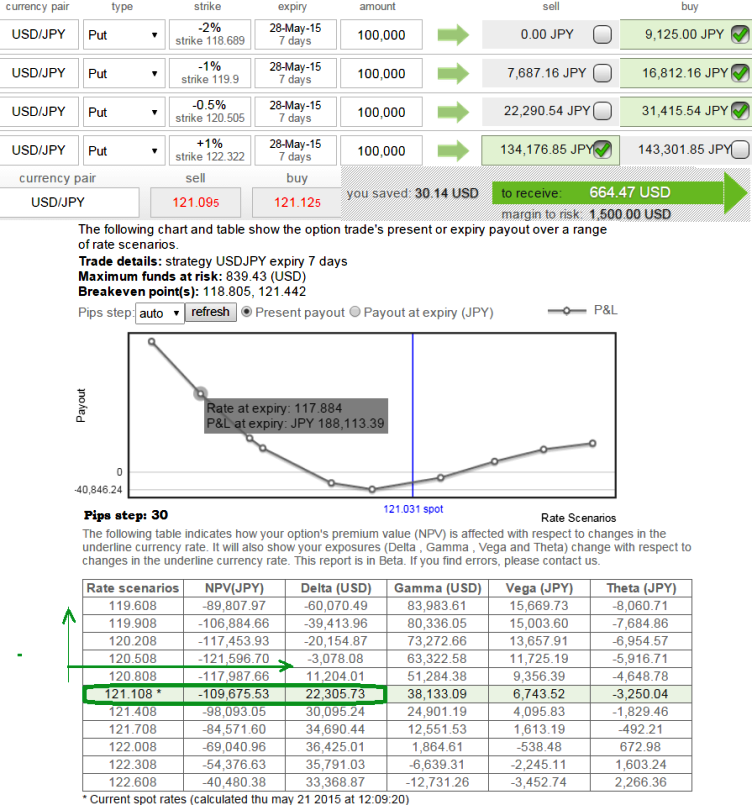
Arrest downside risks of USDJPY hedging through deploying option strategy: Put Ratio Back Spread
Expect the underlying currency cross (USDJPY in this case) to make a large move on the downside.
Purchase puts (OTM) and sell fewer puts of a higher strike (ATM or ITM) usually in a ratio of 2:1, 3:2 or 3:2.
This is more attractive and quite unusual strategy. Basically, you're selling an at-the-money short put spread in order to help pay for the extra out-of-the-money long put.
The higher strike short puts finances the purchase of the greater number of long puts and the position is entered for no cost or a net credit.
The underlying exchange rate has to make substantial move on the downside for the gains in long puts to overcome the losses in the short puts as the maximum loss is at the long strike.
Give it an adequate time to expiration so as to make a substantial move on the downside.
Delta advantage: As shown in the figure it is observed that the this strategy offers positive delta (22,305.73) at prevailing exchange rate which means we are long on USDJPY in underlying market. So, we are participating in dollar as long as it holds its strength but when JPY gains appreciation delta turns into negative (-3,078.08) which means we are also participating on downswings as well.

- News

- Economy

- Central Banks
- Investing
- Research
- Roundups
- Digital Currency
- Insights
- Technical Analysis
- Technology
- Business
- Law
- Health
- Nature
- Fintech
- Science
- Topic
- Opinions
- ©Econometrics LLC . All Rights Reserved.
Delta advantage on Put Ratio Back Spread of USDJPY
Thursday, May 21, 2015 7:25 AM UTC
Editor's Picks



- Market Data
Most Popular




