


 Goldman Sachs Flags 3 Key Risks Ahead of Europe’s Earnings Season
  Trump has made more than $1 billion from crypto in a year. How?
  Goldman Sachs Raises USD/JPY Forecast, Sees Yen Weakness Persist Through 2027
  In a rebuke to Trump, the Supreme Court rules that birthright citizenship is the law of the land
  Alcohol is one of the most dangerous drugs, yet its presence is ubiquitous in social settings and celebrations
  Elon Musk is remaking the world, like Henry Ford before him – but more dangerously
  Smartphones are helping filmmakers tell the stories the movie industry overlooks
  JPMorgan Cuts Gold Price Forecast, Sees Bullion Reaching $4,500 by End of 2026
  Gold Surges Past $4150 on Dovish Fed Signals and Weak Jobs Data; Bullish Outlook Prevails
  Gold Pulls Back After Hitting $4,180 as Geopolitical Risk Sends Crude Higher


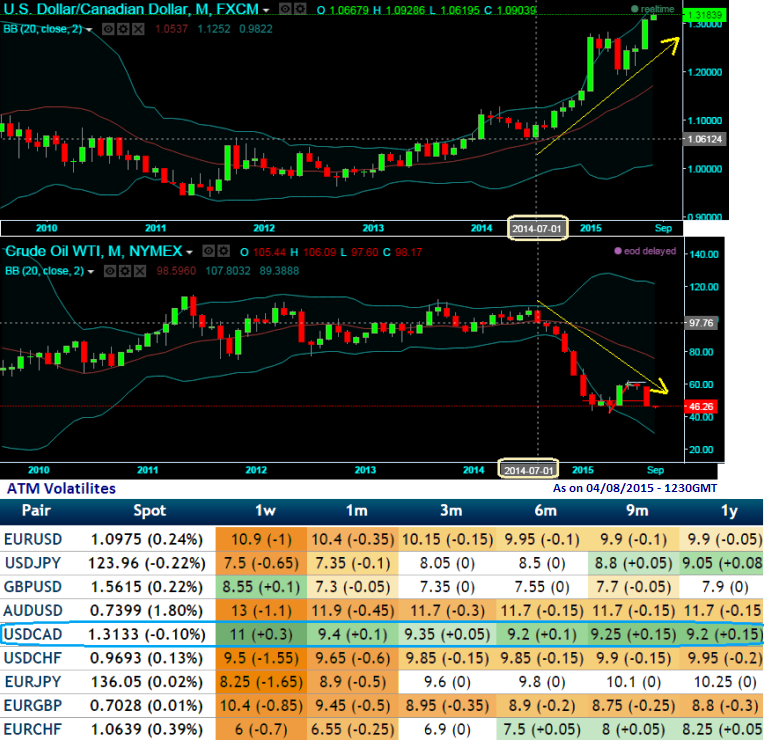
Ever since January 2014 the crude prices have been in negative correlation with USD/CAD, The above chart evidences the same every bit of movements in both prices. The significance of crude for the Canadian dollar is not mere the value of its single largest exporting capacity but it is an extra common substitute in the present situation for the general Canadian economy that had become highly leveraged to oil prices. Like U.S, home equity loans that bolstered consumption, investment and asset prices.
It has been almost more than a year that the crude oil front month light sweet crude and Canadian dollar have been diverging in the opposite direction. However, the capital inflows and outflows of Canada swamp the oil exporting valuations which are also offset by the fact that provinces in the east import oil.
In 2014, Canada exported almost close to $105 bln of energy goods and imported about $46 bln of energy goods. Let's not forget that Canada is an important exception to the US ban on oil exports. In fact, the conventional model has been for the eastern regions to import more expensive Brent, while a few western provinces export cheaper oil to the US.

- News

- Economy

- Central Banks
- Investing
- Research
- Roundups
- Digital Currency
- Insights
- Technical Analysis
- Technology
- Business
- Law
- Health
- Nature
- Fintech
- Science
- Topic
- Opinions
- ©Econometrics LLC . All Rights Reserved.
Comparative analysis indicates crude and loonie still moving in indirect proportionate swings
Wednesday, August 5, 2015 9:51 AM UTC
Editor's Picks



- Market Data
Most Popular




