


 Japan, U.S. Discuss Yen Weakness as Currency Intervention Concerns Grow
  FxWirePro: Daily Commodity Tracker - 21st March, 2022
  South Korea’s KOSPI Rebounds as Samsung and SK Hynix Lead Tech Stock Recovery
  Best Gold Stocks to Buy Now: AABB, GOLD, GDX
  U.S.-Iran Diplomacy Helps Drive Gasoline Prices Down 15% From May Highs
  Wall Street Slides as AI Stocks Tumble Following South Korea Tech Sell-Off


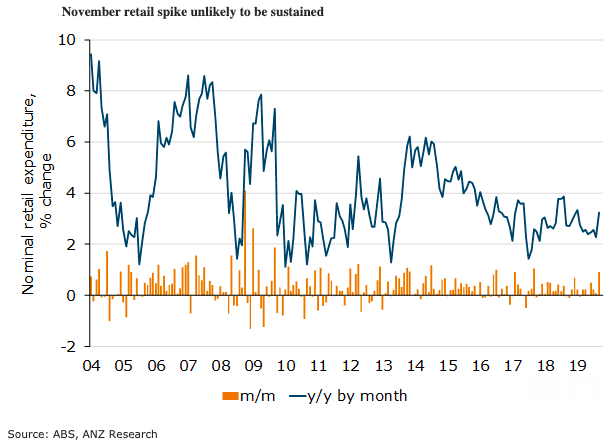
Australia’s annual growth in retail sales lifted to 3.2 percent y/y in November. This is the strongest y/y result by month since March, and is above the average yearly growth result for the last three years.
However, this is unlikely to be sustained, as some of the strength in November is likely to result in symmetrical weakness in December, as people pulled forward their discretionary spending for Black Friday, ANZ Research reported.
Black Friday pushed up non-food sales, which grew 1.2 percent m/m, compared to 0.6 percent m/m for food sales. This nominal difference is subdued compared with what likely happened to volumes, as food prices have been rising faster than non-food prices in the last year. Black Friday’s heavy discounting likely pushed down average prices for non-food sales in November.
Department stores (3.4 percent m/m), fashion (3.1 percent m/m) and electronics (2.1 percent m/m) drove the strong result for November. Takeaway food also grew well (2.1 percent m/m), after sales in the category went backwards the last few months.
Annual growth results show the persistence of subdued household spending on non-essential categories, as food rose 3.7 percent y/y while non-food only rose 2.7 percent. Fashion (4.9 percent y/y), department stores (4.4 percent y/y), pharmaceuticals, cosmetics and toiletries (4.3 percent y/y) were the strongest non-food categories, while household-related categories and recreation were weakest.
Monthly growth was weakest in the South East in both October and November. NSW grew only 2.1 percent y/y, while VIC and SA grew 2.9 percent and 3.0 percent y/y respectively. Qld (5.4 percent y/y) and Tas (5.3 percent y/y) led annual growth.
"The bushfires and smoke haze may downgrade retail sales over December and January and fundamental difficulties for households, including sluggish wage growth, high household debt and rising non-retail expenses (such as utilities, housing, education and health) are likely to keep a lid on retail growth for at least the early part of 2020," ANZ research further commented in the report.







