


 FxWirePro: Daily Commodity Tracker - 21st March, 2022
  Morgan Stanley Sees Chinese Auto Market Recovery Gaining Momentum in Late Summer
  Oil Prices Drop as Strait of Hormuz Shipping Recovers
  Gold Falls Below $4,000 as Strong Dollar and Fed Rate Hike Expectations Weigh on Prices
  Trump Threatens 100% Tariffs on Countries Imposing Digital Services Taxes on U.S. Tech Firms
  Wall Street Ends Lower as AI Stocks Drag Markets, Fed Rate Outlook Shifts
  Australia Jobs Growth Strengthens Rate Hike Outlook
  Japan Signals Preference for Low Interest Rates as BOJ Policy Debate Intensifies


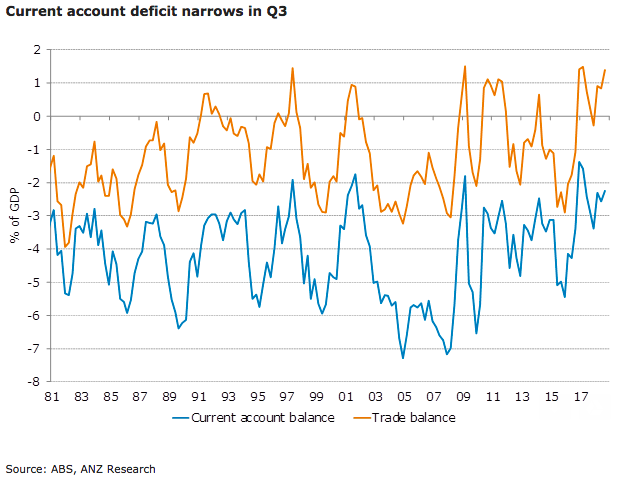
Australia’s current account deficit narrowed during the third quarter of this year, driven by an improvement in the trade balance offsetting a deterioration in the income balance. Net exports made a slightly larger-than-expected contribution, due to a fall in import volumes.
The country’s CAD narrowed to AUD10.7 billion from a revised estimate of AUD12.1 billion in Q2 (originally AUD13.5 billion). This equates to 2.2 percent of GDP, from 2.6 percent in Q2.
An improved trade balance drove the decrease, coming in at a surplus of AUD6.6 billion compared to AUD3.9 billion in Q2. This offset a deterioration in the income balance to a deficit of AUD16.9 billion (from a deficit of AUD15.8 billion in Q2). That equates to 3.6 percent of GDP, the highest since Q2 2011.
Net exports will make a solid contribution to Q3 GDP. The 0.4ppt they are adding is the highest since Q1 2016 and slightly above consensus. Exports volumes rose by 0.1 percent q/q led by a 4.5 percent increase in services. Resource exports were a drag, falling 1.5 percent, while rural goods increased 0.5 percent and manufacturing goods increased 2.1 percent.
Import volumes fell 1.5 percent q/q with a 2.5 percent drop in consumption goods and 2.2 percent fall in capital goods driving the decline. Within these categories, automobiles fell 3.9 percent and machinery and equipment declined 4.2 percent. Intermediate and other goods rose 0.2 percent, while service imports were virtually unchanged. The terms of trade rose by 0.8 percent q/q, and 2.7 percent y/y.







