


 Asian Markets Rally as Micron and Qualcomm AI Outlook Lifts Global Tech Stocks
  New Zealand Fast-Tracks Gold Mining as Industry Revival Gains Momentum
  South Korea Stocks Tumble as AI-Fueled Rally Faces Profit-Taking Pressure
  Australia Inflation Cools in May, But Core CPI Keeps RBA Rate Hike Risks Alive
  Australia Jobs Growth Strengthens Rate Hike Outlook
  Asian Stocks Slide as AI Rally Pauses, South Korean Chipmakers Lead Regional Decline
  Yen Near 40-Year Low as USD/JPY Approaches Key 162 Level, Raising Intervention Concerns
  U.S. Dollar Reaches One-Year High as Tech Sell-Off and Fed Rate Hike Expectations Support Demand
  Singapore Inflation Stays Muted in May as Core CPI Misses Forecasts Ahead of MAS Review
  Wall Street Ends Mixed as Tech Stocks Struggle Ahead of Micron Earnings


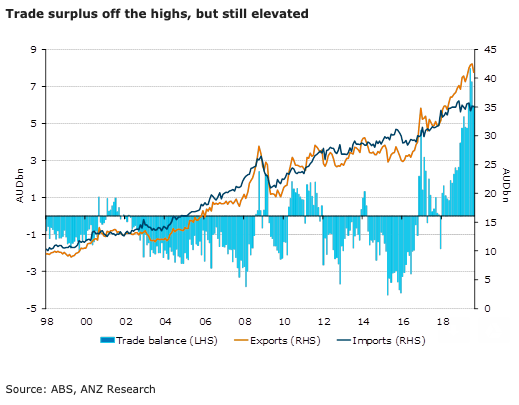
Australia’s trade surplus in August fell in line with expectations, as export values dipped in the month and imports were broadly steady. The main drag on exports was from non-rural goods, reflecting the drop-off in iron ore prices. Service exports rose during the month and should continue to grow, helped by the weaker AUD, ANZ Research reported.
The monthly trade surplus dipped to AUD5.9 billion, still high but down from July’s revised surplus of AUD7.3 billion. Underlying this was a 3.4 percent m/m decline in exports, while imports were down 0.4 percent m/m.
Total resource exports fell 5.5 percent m/m in August, led by a 10 percent decline in metal ores and minerals, while coal fell 4 percent. The volatile non-monetary gold component declined 22 percent (an AUD601 million fall). Manufacturing goods exports were down 2.3 percent but rural goods increased 1.4 percent, helped by 5 percent increases in both cereals and meat. Service exports rose 0.6 percent, as travel increased 0.7 percent.
Capital goods imports dropped 1.9 percent m/m, with a 5.4 percent fall in machinery and equipment more than offsetting 4.2 percent and 26.2 percent rises in transport equipment and civil aircraft, respectively.
Consumption goods imports fell 0.9 percent as household electrical items dropped 3.2 percent. Intermediate goods imports, excluding fuel, fell 3.6 percent as parts for capital goods declined 3 percent. Fuel imports declined 7.2 percent. Service imports rose 1.9 percent as travel rose 0.8 percent.
"Overall, the peak in the trade surplus is in the rear view mirror. However, we expect surpluses to continue, albeit diminishing slowly over time, as the boost from the prior surge in iron ore prices fades," the report further commented.







