


 Best Gold Stocks to Buy Now: AABB, GOLD, GDX
  European Stocks Slip as Middle East Tensions and Hormuz Threat Rattle Markets
  China Home Prices Fall Again in June Despite Slower Pace of Decline
  Asian Stocks Rally as Cooling U.S. Inflation Boosts Fed Rate Cut Hopes
  Singapore GDP Grows 5.7% in Q2 2026 as AI-Driven Manufacturing Boosts Economy
  Gold Price Holds Near Record High as Cooling U.S. Inflation Offsets Fed Caution
  China Q2 2026 GDP Misses Forecast as Weak Domestic Demand Offsets Export Strength
  Australia Consumer Sentiment Rises in July as Fuel Price Relief Lifts Confidence


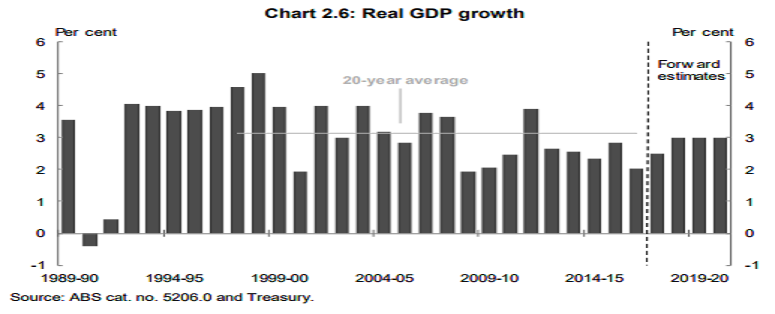
Australia has lowered its forecasts for real GDP growth in 2017-18 in its Mid-Year Economic and Fiscal Outlook (MYEFO), given a slowdown in household consumption. However, it also lowered its forecast for the unemployment rate for 2017-18 and 2018-19, reflecting robust employment growth.
Further, the outlook also revealed an expected budget deficit of AUD23.6 billion for 2017-18, a AUD5.8 billion improvement on the estimate announced in May. The key driver for improvement was the better conditions among businesses, which have in turn lifted the projected tax intake from companies. A combined improvement of AUD9.4 billion is expected over the four years to 2020-21. The expectation that a surplus will be reached in 2020-21 remains intact.
The fact that commodity prices are no longer falling is a big help to the government’s budget. The improvement in business sector conditions and a pickup in global growth should continue to support revenues. The ongoing strength in the labor market would also assist in boosting government coffers, although ongoing soft wage growth is expected to keep a lid on income tax receipts.
The downward pressures on the budget in recent years have subsided. As a result, there is a danger that the pressures on the Government to address the longer-term issue of budget repair has reduced. A surplus is expected in 2020-21, but it continues to rely on an ongoing improvement in economic growth. Achieving the aim of having the budget in surplus, on average, over the course of the economic cycle, therefore, remains questionable.
Meanwhile, FxWirePro launches Absolute Return Managed Program. For more details, visit http://www.fxwirepro.com/invest







