


 Israeli Airstrikes Kill 10 Palestinians in Gaza as Ceasefire Diplomacy Stalls
  Domino’s Weighs Appeal After Australian Court Rules Workers Were Misled on Pay
  US Weighs New Sanctions Against Brazil Supreme Court Justice Alexandre de Moraes
  US Eyes Refinery Boost as Trump Seeks Relief From High Gas Prices
  Trump Says Kim Jong Un Responded to Outreach After US Scales Back South Korea Military Drills
  U.S. Unseals Charges Against Five Alleged CJNG Leaders, Raises Reward for New Cartel Chief
  Lebanon Lawyers Seek Probe Into Banker Over Alleged Netanyahu Dinner in Washington
  Meta Ordered to Pay $567M Over Child Safety Violations in New Mexico
  Citadel Warns High Treasury Yields Pose Broader Market Risks


 Add as a preferred source on Google

Following the nearly three-hour oral argument about presidential immunity in the Supreme Court on April 25, 2024, many commentators were aghast. The general theme, among legal and political experts alike, was a hand-over-the-mouth, how-dare-they assessment of the mostly conservative justices’ questioning of the attorneys who appeared before them in the case known as Trump v. United States.
Rather than a laser-focused, deep dive into the details of Trump’s attempt to subvert the 2020 election, virtually all of the nine justices instead raised larger questions, peppered with hypotheticals – hello again, Seal Team Six! – about the reach of executive power, the intent of the nation’s founders and the best way to promote a stable democracy.
Justice Brett Kavanaugh’s “I’m not focused on the here and now of this case” and Justice Neil Gorsuch’s “We are writing a rule for the ages” drew particular fire.
The headline and subheadline on the New York Times analysis by Supreme Court reporter Adam Liptak complained that the court had taken “Trump’s immunity arguments in unexpected direction” with “very little about the President’s conduct.” And the story itself fumed that the justices had responded to Trump’s claim that he should not face charges as a “weighty and difficult question.”
Slate’s Amicus podcast decried the court for failing to focus on the “narrow question” the case presented, instead going “off the rails” and “bouncing all over the map” with various legal arguments. A guest on NPR’s 1A program lamented that the court had “injected new questions” into the oral argument to “slow-walk” the case and prevent Trump from facing trial before the election.
But here’s what the pundits seem to have forgotten: What happened that day in the court should have surprised no one, especially those constitutional scholars like me familiar with Supreme Court procedure.
Five words ‘change everything’
Trump’s case stemmed from his prosecution by Special Counsel Jack Smith for his alleged attempts to overturn the 2020 presidential election. Trump claimed he, as president, was immune from prosecution, and he took his case to the Supreme Court.
When parties appeal their case to the court, they must tell the justices what specific legal question or questions they want the justices to answer. As a colleague and I have explored in a recent academic journal article, the court generally accepts what is called the “Questions Presented” as given, agreeing to hear a case without making any adjustments to its legal framing.
Sometimes, however, the court will alter the legal question in some way. Why it does this is an issue that scholars like myself are just beginning to explore. And because it is that question – not the one the litigant initially asked – that frames the legal analysis, the justices can exert real control over both the case itself and the development of the law.
Trump v. United States is a classic example. When attorneys for the former president filed their request with the court, the question presented by them was “Whether the doctrine of absolute presidential immunity includes immunity from criminal prosecution for a President’s official acts.”
When it granted the petition in late February 2024, the court changed this language to “Whether and if so to what extent does a former President enjoy presidential immunity from criminal prosecution for conduct alleged to involve official acts during his tenure in office.”
Five of those additional words – “if so to what extent” – changed everything. They sent a clear-as-day signal that the court would move well beyond the simple yes-or-no of whether Trump could be prosecuted.
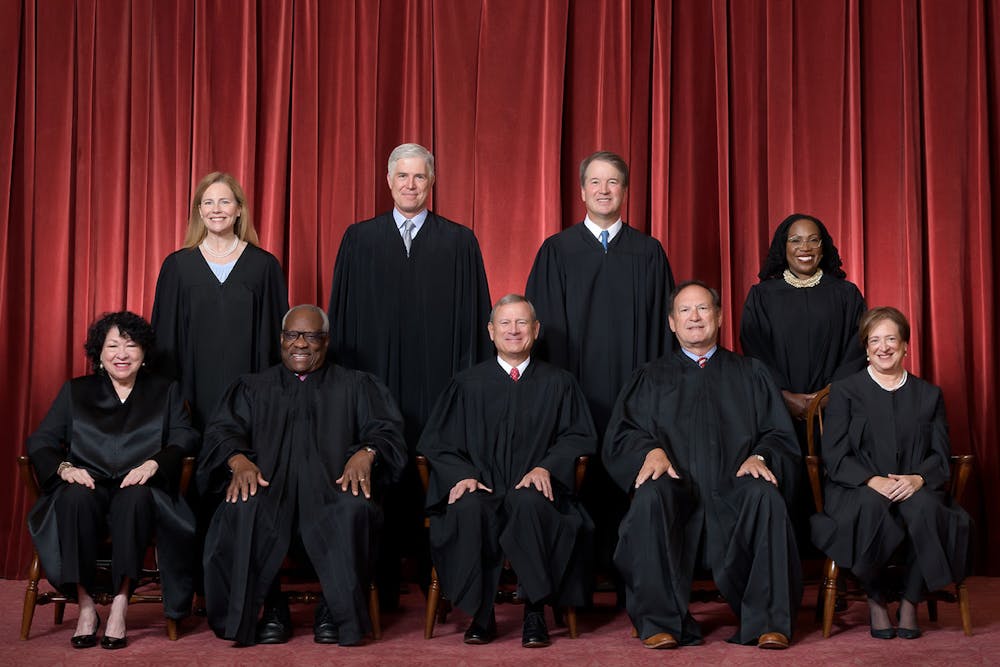
The full Supreme Court, with nine justices, heard oral arguments in the immunity case. Fred Schilling, Collection of the Supreme Court of the United States
The court doing its job
With their reformulation of the question, the justices would instead be determining how, when and for what acts any president could ever be held criminally responsible.
That is a much larger inquiry, one that necessarily involves formulating a legal test to draw a line between what is constitutionally permissible and what is not. That the justices spent oral argument trying do exactly that is not a problem, much less an outrage: It’s just the court, the highest appellate court in the land, doing its job.
The scope of the argument, the expansiveness of the coming opinions and the time suck for the justices to write them and the possible vanishing of Trump’s prosecution are not at all shocking. The court signaled it would address the broader question months ago when it took the case; the time to fault the court for making the case about more than just Donald Trump was then, not now.
But perhaps commentators’ response to the oral argument can be a good lesson. Americans are told to take Trump at his word, expecting his second term to contain all the extremes he gleefully says it will.
When the Supreme Court indicates what legal question it will answer, the smart response is to do the same thing – pay attention and believe. This may not make the ultimate outcome any less distasteful to many, but at least it won’t be quite as disturbing.







