


 California ICE Detention Center Found to Have Inadequate Medical Care, Court Monitor Says
  Australia’s Corporate Leaders Face Parliament Over KPMG Client Data Scandal
  China is launching a Moon mission to find water ice. It’s unlike anything NASA has done
  Prince Harry Faces Potential Multi-Million-Pound Legal Bill in Daily Mail Case
  Moody’s Affirms NVIDIA Aa1 Rating as AI Data Center Guarantees Reach $105 Billion
  DOJ Subpoenas New York Times Freelancer Over North Korea Military Report
  CK Hutchison Seeks $1.5 Billion From Panama Over Canal Ports
  Lebanon Lawyers Seek Probe Into Banker Over Alleged Netanyahu Dinner in Washington
  Barclays Downgrades Renault as Cost Savings Challenges Grow
  29 US states are suing Meta. What might it mean for the rest of the world?
  Sun Pharma Wins U.S. Appeal in Pfizer Lipitor Antitrust Case
  AI Avatar of Jair Bolsonaro Sparks Legal Battle Ahead of Brazil’s 2026 Presidential Election
  Warner Bros. Discovery Shares Rise as Newsom Pushes Settlement in $110 Billion Merger Fight


 Add as a preferred source on Google

Google has been dragged over the coals by the European Union’s competition watchdog, culminating in the European Commission formally charging Google with abusing the dominant position of its Android mobile phone operating system, having launched an investigation in April 2015.
Powerful firms are prohibited from engaging in anti-competitive behaviour under Article 102 of the Treaty on the Functioning of the European Union, or TFEU. European law calls this an abuse of dominant position, but really it can be seen simply as bullying. The EU courts have long recognised that dominant firms have “a special responsibility not to allow [their] conduct to impair genuine undistorted competition”.
To violate EU competition law a firm must be dominant in a particular market – just having a large market share indicates dominance, but isn’t sufficient. Other factors need to be studied, such as barriers to market entry and exit, or switching costs. A market that is easy to enter despite one firm having a large share of it may still be contestable by newcomers.
The conduct of firms with dominant positions is subject to particular scrutiny for evidence of abusive conduct, such as that aimed at eliminating actual or potential competitors or exploiting consumers. If any abusive behaviour is found, the European Commission has the power to demand changes to contracts and impose fines of up to 10% of the firm’s annual turnover. In the case of Google, this would be an eye-watering US$7 billion, based on its 2015 revenues. Any such sanctions are subject to review by the EU courts.
What are the allegations?
The European Commission considers that Google is dominant in three markets: general internet search, licensable mobile operating systems as used on smartphones and tablet computers, and stores for Android apps. It considers that Google controls more than 90% of each market.
It’s important to understand that Android is essentially composed of two parts. The first is the open source operating system core, which everyone can use, alter, change, repackage and re-release as their own. The other is proprietary, which is closed source and belongs to Google, which keeps it to itself. This means that a firm manufacturing mobile phones must buy a licence from Google to use the proprietary part of Android, even though the rest of it is open source and free.
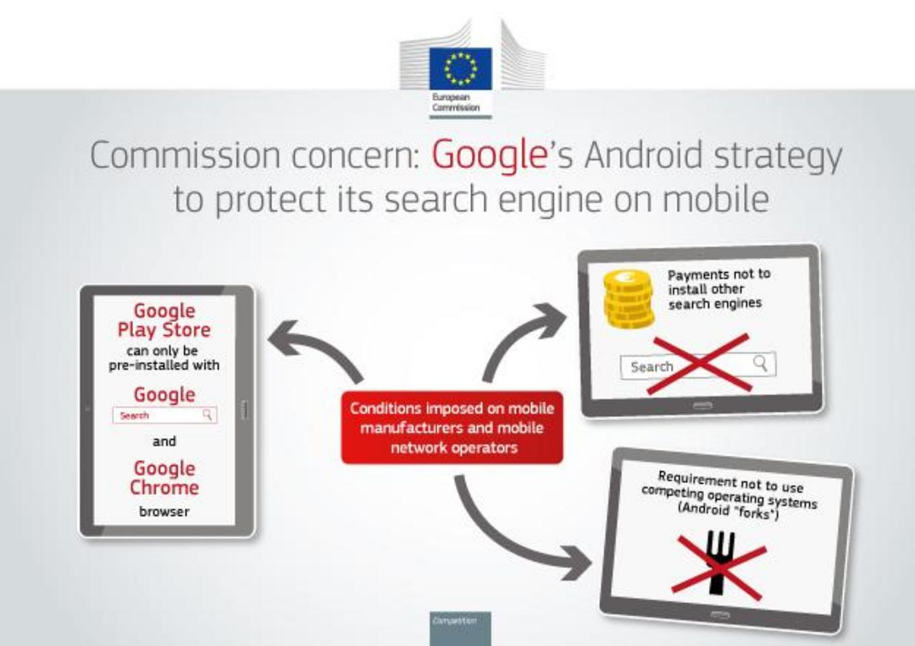
Google, the commission argues, violated EU rules by requiring manufacturers to pre-install Google Search and its Chrome browser and obliging them to make Google Search a default search service as a condition of being granted a license for Google’s proprietary apps, particularly the Play Store app which is the key marketplace for Android-compatible apps.
Google also prevents manufacturers from selling devices running on any non-standard variations of the Android operating system (known as “forks”) – and offers financial incentives to manufacturers and mobile phone networks if they exclusively pre-install Google Search on their devices.
This behaviour has an essentially foreclosing effect – it makes it difficult for other firms to compete with Google, and reinforces Google’s dominance in general search – its most profitable business area. It may also harm consumers by denying them access to devices run on competing Android forks, thereby stifling innovation.
Is Google the new Microsoft (legally speaking)?
These are serious charges. They resemble similar anti-competitive charges brought against Microsoft 20 years ago for bundling a media player and web browser with its Windows operating system. One difference lies in the fact that Microsoft built its products into each other, technologically, whereas Google bound them together contractually.
However, manufacturers can use the open source Android, but they cannot pre-install the proprietary Google apps, including the Play Store, which as the main Android app marketplace is seen as critical. There are other app stores available for Android, for example Amazon Appstore, but none has a comparable library of apps. What’s more, Google’s approach is all-or-nothing: installing the Play Store means installing all the other Google apps in the bundle, such as Google Search, the Chrome browser, or Gmail app. The effect is that Google’s own apps are given unparalleled presence and visibility, leveraging and strengthening Google’s dominant position.
In its first response, Google underlined the voluntary character of the agreements and the open source nature of Android. It argued that Android was designed “in a way that’s good for competition and for consumers”.
Google has 12 weeks to formally respond and show that any such restrictions are legitimate. Some, particularly in the US, argue that the European Commission is obsessed with scrutinising US tech firms. But the US Federal Trade Commission recently opened a similar investigation, so it is not, as some have suggested, anti-US sentiment. But with differences between EU and US law, where US law tends to be more lenient with larger firms, it’s not clear that the two bodies will come to the same conclusions.
 Marek Martyniszyn does not work for, consult, own shares in or receive funding from any company or organization that would benefit from this article, and has disclosed no relevant affiliations beyond the academic appointment above.
Marek Martyniszyn, Lecturer in Law, Queen's University Belfast
This article was originally published on The Conversation. Read the original article.







