


 Japan Manufacturing Growth Accelerates in June as Orders Surge Despite Iran War Cost Pressures
  Wall Street Ends Mixed as Alphabet Slumps, Middle East Developments and Fed Outlook Weigh on Markets
  South Korea Stocks Tumble as AI-Fueled Rally Faces Profit-Taking Pressure
  Oil Prices Drop as U.S.-Iran Talks Ease Supply Concerns
  Singapore Inflation Stays Muted in May as Core CPI Misses Forecasts Ahead of MAS Review
  Asian Stocks Slide as AI Rally Pauses, South Korean Chipmakers Lead Regional Decline
  Dollar Holds Firm as U.S.-Iran Talks Ease Tensions, GBP/USD Slips Amid UK Political Uncertainty


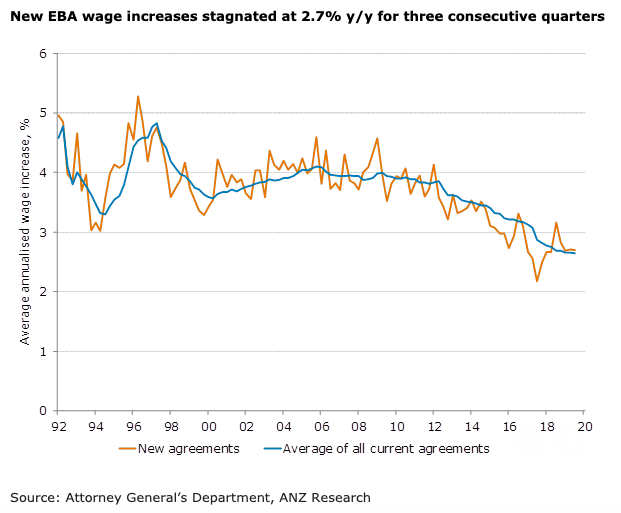
The average annual wage increase (AAWI) under new enterprise bargaining agreements (EBAs) has idled at 2.7 percent for the three quarters to September 2019. The private sector recorded a slight decline to 2.7 percent in Q3, which was largely offset by a small rise in the public sector to 2.6 percent, ANZ Research.
The average annual wage rise for all current agreements slowed to a record low of 2.6 percent in Q3. The EBA data are consistent with the weakening in the wage price index to 2.2 percent y/y in Q3.
The AAWI in the private sector has gradually declined over the past three quarters to 2.7 percent in Q3. This was largely offset by a small rise in the public sector AAWI to 2.6 percent, although this is still well down on the 3.3 percent recorded a year ago.
The Q3 results were mixed across industries. The largest declines in the AAWI under new EBAs were in arts and recreation (-0.5ppt), accommodation and food services (-0.4ppt), and transport, postal and warehousing (-0.4ppt).
The largest improvement was in rental, hiring and real estate (+1.4ppt to 3.5 percent), but this AAWI is still less than half of what it was a year ago. Construction, other services, utilities and retail also recorded rises in the AAWI for new agreements.
Only three out of the 19 industries had an AAWI at or above 3 percent: construction; rental, hiring and real estate; and utilities.
"We do not expect a material pick-up in wage growth any time soon," the report further commented.







