


 Thousands of satellites are due to burn up in the atmosphere every year – damaging the ozone layer and changing the climate
  Fungi are among the planet’s most important organisms — yet they continue to be overlooked in conservation strategies
  How is Antarctica melting, exactly? Crucial details are beginning to come into focus
  Big AI wants to slow down AI research. Is it a safety pause or a strategic retreat?
  How ongoing deforestation is rooted in colonialism and its management practices
  Ukraine minerals deal: the idea that natural resource extraction can build peace has been around for decades
  Europe can’t achieve space sovereignty alone. Here’s why
  Synthetic data could ease people’s concerns about privacy breaches. But who gets to create it?
  Lake beds are rich environmental records — studying them reveals much about a place’s history
  ‘Buy now, pay later’ doesn’t feel like debt. For young people, that can be a big problem
  How America courted increasingly destructive wildfires − and what that means for protecting homes today


 Add as a preferred source on Google

Microplastics are tiny plastic particles that can cause big problems when they enter the water supply. One way my fluid dynamics lab explores microplastic movement is by studying how tiny water-walking insects are pushed underwater by raindrops.
Exposure to microplastic pollution can pose health risks, such as respiratory and digestive problems, increased risk of diabetes and disrupted sleep. But physicists like me can study how they move through water to learn how to clean them up.
Water striders are tiny insects that can walk on water. They’re abundant in humid, rainy areas, and some species go their entire lives without ever touching land. Raindrops can weigh more than 40 times a water strider, and during storms they occasionally strike striders directly. The drops form a tiny crater under the surface of the water that envelops the strider before jettisoning it out as the crater collapses back to the surface.
The water striders have strong exoskeletons that allow them to survive being hit by a raindrop. Because these insects are water-repellent and very lightweight, they usually bounce right back. But sometimes the raindrops will form a second, smaller crater right below the surface. The second crater usually forms from a large, fast drop.
If the water strider finds itself inside this second crater, it could get trapped under the water.
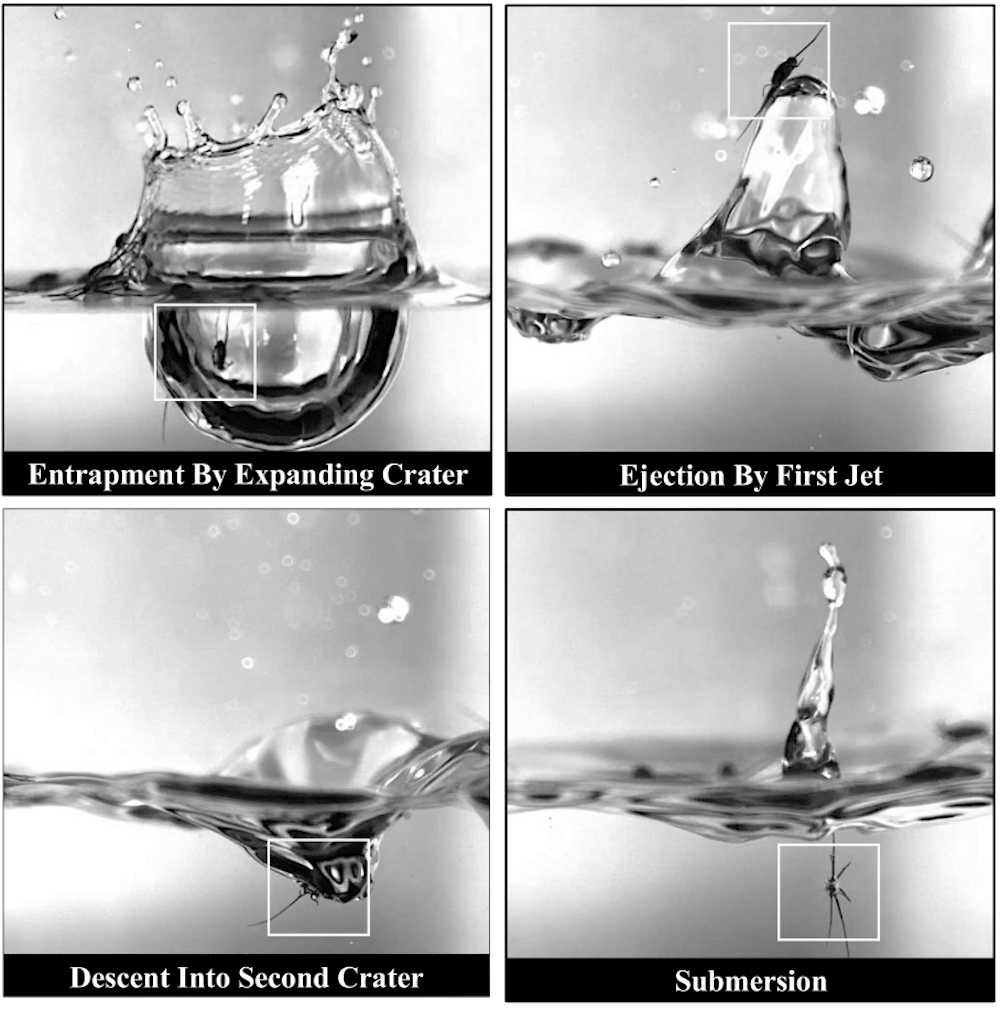
Raindrops form two craters, the second of which can submerge striders. Daren A. Watson and Andrew K. Dickerson, from the Proceedings of the National Academy of Sciences
In my lab’s latest study, we captured water striders from local ponds and released falling drops above their tanks. We used high-speed videography and image analysis to see how fast the insects submerged when the raindrops hit them.
My colleagues and I also measured the acceleration of the second, smaller crater. This crater retracts quickly – according to our measurements, 50 times the acceleration due to gravity. Water striders cannot support themselves inside this second bubble, as the surface they’re on moves upward so quickly, and they might fall underwater and become submerged. If that happens, the water striders make powerful swimming strokes to try to resurface.
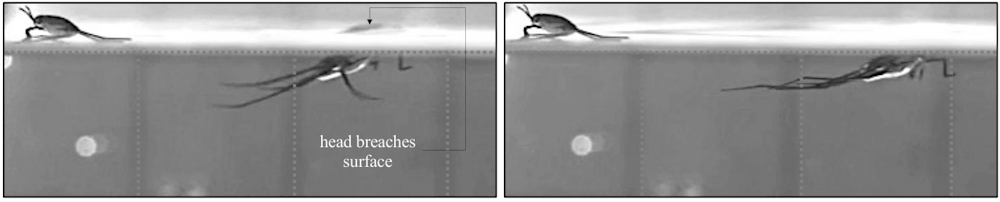
Striders can often kick back up to the surface if they get submerged, unlike plastic particles. Daren A. Watson and Andrew K. Dickerson, from the Proceedings of the National Academy of Sciences
Why it matters
Like water striders, microplastics are very light and often water-repellent. They tend to move on top of the water in a similar way, and raindrops can submerge them. When pollutants get submerged, they’re harder to clean up, and marine life might consume them.
Our research tells us that the second crater’s quick acceleration toward the water’s surface plays a big part in sinking tiny particles – water striders and microplastics alike.
Studying how small particles and organisms disperse in water could help scientists figure out how to prevent and mediate microplastic pollution.
What still isn’t known
Water striders are so water-repellent that they carry a bubble around them called a plastron when pushed underwater.
In the lab, the more times they are struck by drops before repelling away the water, the more likely water striders are to remain submerged for extended periods.
Raindrop impacts seem to deplete the plastron. We don’t yet know how many repeated impacts striders can tolerate and how chemical pollutants in waterways affect their resistance to submersion.
What’s next
Future work will replace the water striders in our experiments with floating particles that mimic microplastics, with a range of size, density and water-repellency. We expect larger particles to make the drops break apart upon contact, while the smaller particles will likely get carried into the air, or aerosolized, by the splash.
And the striders aren’t just good models for microplastic movement. Studying water striders’ legs as they swim could also help researchers design underwater robots.







