


 Smartphones are helping filmmakers tell the stories the movie industry overlooks
  Goldman Sachs Says China Competition Weighs More on EU Growth Than Trade Deficit
  Alcohol is one of the most dangerous drugs, yet its presence is ubiquitous in social settings and celebrations
  Goldman AM Sees Strong Buyout Opportunities in Japan, South Korea and Australia
  State of emergency in Crimea as Ukraine focuses pressure on ‘jewel in Putin’s crown’
  In a rebuke to Trump, the Supreme Court rules that birthright citizenship is the law of the land
  Bernstein Names IAG, Ryanair as Top European Airline Stocks Ahead of Earnings
  JPMorgan Cuts Gold Price Forecast, Sees Bullion Reaching $4,500 by End of 2026


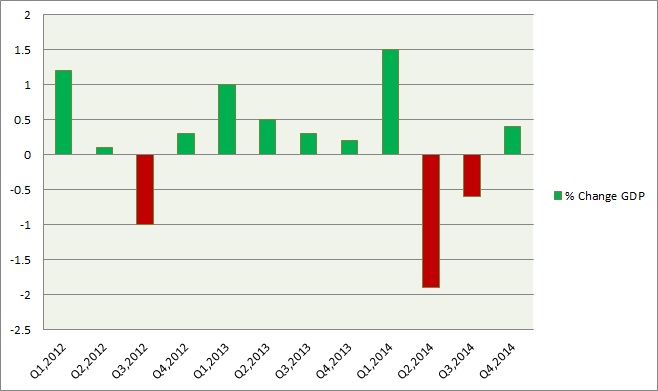
Japan's weaker than expected economic activity continue to pose doubt's on Bank of Japan's Qualitative and Quantitative Easing (QQE) program's effectiveness to boost growth and demand, which in turn is expected to push inflation higher.
As of now QQE's success can only be measured from higher stock market price with Nikkei around highest level in 15 years and Yen to have fallen to weakest level post crisis, which might be benefiting exporters. Hard facts are yet to provide enough evidence of such.
- Today preliminary estimate of Japan's first quarter GDP to be announced at 23:50 GMT. In the last quarter of 2014, Japan has recovered from recession. Growth was 0.4% q/q. GDP growth was record low at -1.9%in the second quarter of 2014, after Prime Minister Shinzo Abe raised consumption tax.
First quarter stands as a test for bank of Japan (BOJ) as it is running out of tools to deploy. It was initially supposed to meet its 2% inflation target by 2015, originally envisaged when the program was launched in late 2012. However BOJ officials later scrapped the target.
Yen is currently trading at 120.4 against dollar, very close to its resistance around 120.5-120.8. Better than expected GDP might push yen higher.







