


 Lake beds are rich environmental records — studying them reveals much about a place’s history
  Wildfires ignite infection risks, by weakening the body’s immune defences and spreading bugs in smoke
  Drug pollution in water is making salmon take more risks – new research
  How is Antarctica melting, exactly? Crucial details are beginning to come into focus
  Extreme heat, flooding, wildfires – Colorado’s formerly incarcerated people on the hazards they faced behind bars
  Burkina Faso and Mali’s fabulous flora: new plant life record released
  Rice feeds billions of people – but its role in fueling climate change is growing
  Thousands of satellites are due to burn up in the atmosphere every year – damaging the ozone layer and changing the climate
  As the Black Summer megafires neared, people rallied to save wildlife and domestic animals. But it came at a real cost
  GesiaPlatform Launches Carbon-Neutral Lifestyle App ‘Net Zero Heroes’
  The UK is surprisingly short of water – but more reservoirs aren’t the answer
  Rise of the Zombie Bugs takes readers on a jaw-dropping tour of the parasite world
  How to create a thriving forest, not box-checking ‘tree cover’
  What’s so special about Ukraine’s minerals? A geologist explains


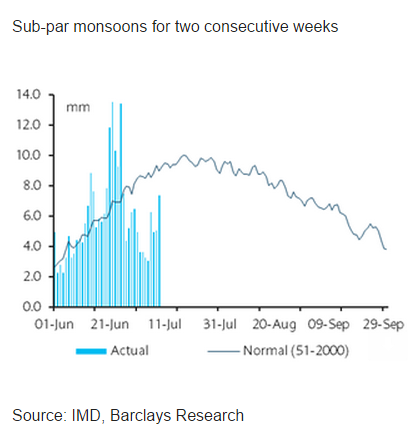
The south-west monsoon rains have gone into deficit again. After a significant improvement in late June, rainfall conditions have deteriorated in past two weeks. Cumulative rainfall between 1 June and 9 July stood at 4% below normal, down from a 10% surplus last week. This drop came as rainfall was 51% below normal last week. A silver lining is that despite below-normal rains, the geographic distribution of rainfall remains favourable, with 26 out of 36 regions still showing excess or normal rainfall conditions. Also, the water stock has improved in 91 major reservoirs, with levels as of 2 July 129% of levels seen last year.
July-August remain the key months for monsoons, and next four weeks account for ~30% of total seasonal rainfall. The Indian Meteorological Department (IMD) has forecast rainfall to be below normal in July and maintains that seasonal forecast is likely to be at 88% of the long-period average. Another private agency Skymet, however, is forecasting rainfall to be normal in July. Sowing activity continues to pick up and was up ~57% relative to 2014 as of 3 July, with strong increases seen in pulses (~132%) and oilseeds (403%). The government has also made inflation management a top priority by placing import orders for wheat, pulses and oilseeds.
In its recent statement, the Reserve Bank of India (RBI) noted that monsoon-related risks dominate its concerns around inflation, although the governor recently noted that the progress of the monsoon this year has been good. Although India's headline inflation remains manageable, risks around food inflation persist.
Barclays notes:
- We think the lack of an increase in MSPs in mid-June for the summer crops is a welcome sign.
- We forecast FY 15-16 average CPI inflation of 5% (H1 FY 15-16: 4.5%, H2 FY 15-16: 5.5%).
- We expect monetary policy in the coming months to remain data dependent. Despite the RBI's recent cautious guidance, the risk of another cut in H2 FY 15 remains, in our view.
However, a potential cut will remain contingent on greater clarity on a number of factors, including trends in commodity prices, the monsoon outcome, the likely 2016 inflation trajectory and the impact of a potential Fed rate hike, possibly in H2 15.







