


 Lithium Market Poised for Recovery Amid Supply Cuts and Rising Demand
  Goldman Sachs: US Dollar Likely to Stay Strong Despite Oil Price Retreat
  Goldman Predicts 50% Odds of 10% U.S. Tariff on Copper by Q1 Close
  Moody's Upgrades Argentina's Credit Rating Amid Economic Reforms
  2025 Market Outlook: Key January Events to Watch
  China’s AI Manufacturing Boom Masks Weak Consumer Economy, Citi Says
  Urban studies: Doing research when every city is different
  Global Markets React to Strong U.S. Jobs Data and Rising Yields
  Trump’s Iran Strategy: What Has Been Achieved After Three Months of Conflict?
  World Cup technology: from ref cams to AI analysts, cutting-edge research is changing the game
  US Gas Market Poised for Supercycle: Bernstein Analysts
  Oil Prices Dip Slightly Amid Focus on Russian Sanctions and U.S. Inflation Data


We open a short position in AUD this week, in part because it offers exposure to a more extended period of soul searching around China (these policy-induced mini cycles tend to be reasonably durable and exploitable), in part because we believe that the risks of a resumption of the RBA’s easing cycle are not adequately priced.
Our preference is for EURAUD rather than AUDUSD as the removal of French political risk clears the way for real money investors to re-weight their portfolios back to European assets in keeping with the outperformance of the region.
EURAUD also serves to partly hedge the handful of short EUR cross positions we hold where a hoped-for improvement in local currency factors is either absent (SEK) or inadequate to compensate for the broad-based rehabilitation of EUR sentiment (CHF and CZK).
We’re adding EURAUD to boost our overall EUR exposure as the passage of the French election this weekend should clear the way for an intensification of portfolio inflows into the region in keeping with the cyclical acceleration in the region’s economy (the Italian election is too distant a prospect to command a risk premium).
AUD, by contrast, is likely to be weighed down, firstly by its stand-out sensitivity to China sentiment (underlying economic linkages and Australia’s status as a liquid proxy for China), and secondly by the downside risks to RBA policy in 2H17, including from a housing market that’s not liking its macro-prudential medicine. There’s the risk of a tactical bounce in AUD from next week’s Federal budget (more infrastructure spending?), but this should be short-lived.
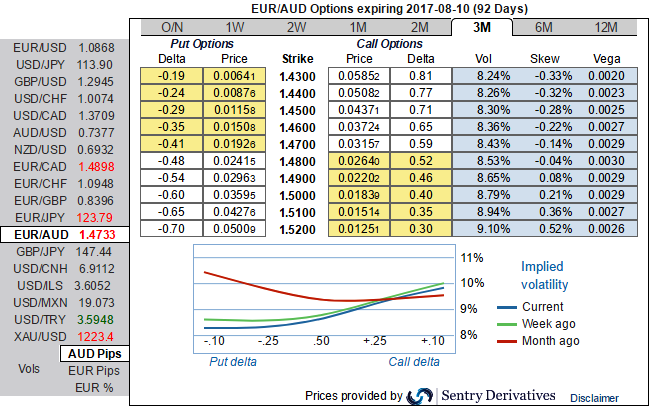
Let’s glance on sensitivity tool for 3m IV skews would signify the interests of OTM call strikes that means the ATM calls higher likelihood of expiring in-the-money, so writing overpriced OTM puts would be a smart move to reduce hedging cost.
While AUDUSD still signals highest bearish sentiments among G10 currency space in next 3 month’s timeframe.
So, you would cross the threshold into a risk reversal if you want to hedge your underlying risk while lowering the cost of the premiums. Here OTC FX market indicates, this APAC currency pair seems more sensitive towards downside risks, as a result, puts looks to be overpriced.
Hence, the market pricing well reflects this view that the RBA will ‘eventually’ ease below 1.5%.







