


 Big AI wants to slow down AI research. Is it a safety pause or a strategic retreat?
  FxWirePro- Crypto Weekly Alpha: ETF Rebounds, L2 Rallies & Key Resistance Levels
  Who should own the knowledge that underpins AI technology?


 Add as a preferred source on Google
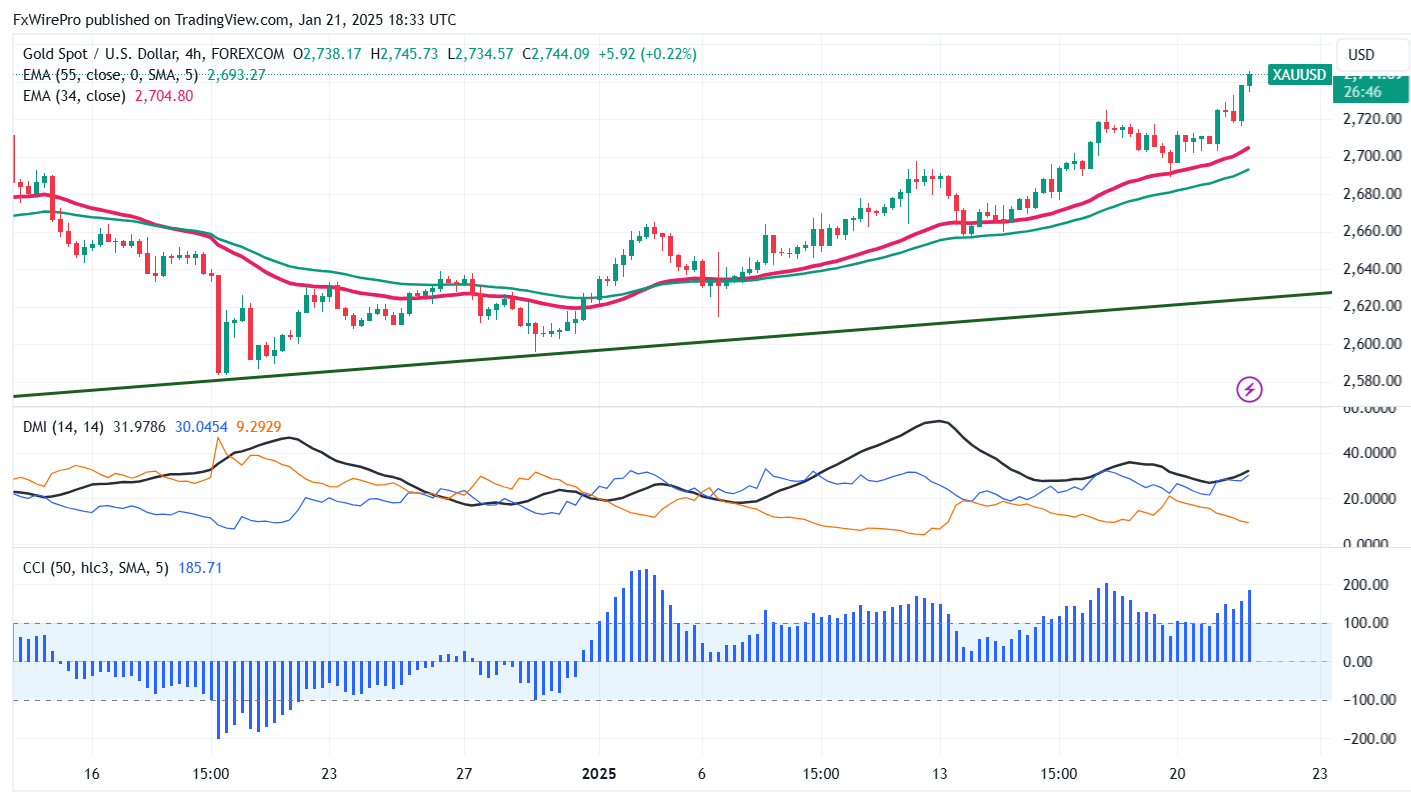
Gold prices trade flat ahead of Trump’s inauguration. It hit a high of $2724.80 and is currently trading around $2706.
At the end of January 21, 2025, gold hit a two-month high of about $2,745 an ounce. Investors were seeking safe havens in the weakening U.S. dollar and over President Trump's trade policies. The dollar decreased by around 0.7%, making it even more inviting for investors from other currencies, and uncertainty of probable tariffs between Canada and Mexico made investors go for gold. This trend emerged when the metal peaked at $2,790.15 in October 2023. More fundamentally, instability in the economic and political front is raising the price of gold.
Rate Pause Sentiments Climb
According to the CME Fed Watch tool, the chances of a rate pause have increased to 99.50% up from 97.90% a week ago.
Technical Analysis: Key Levels and Trading Strategy
Gold prices are holding above the short-term moving averages 34 EMA and 55 EMA and long-term moving averages (200 EMA) in the 4-hour chart. Immediate support is at $2,670, and a break below this level will drag the yellow metal $2660/$2650/$2,630,$2600/ $2,570, $2,559, $2,536, and eventually $2,500. The near-term resistance is at $2750, with potential price targets at $2775/$2790. It is good to buy on dips around $2680, with a stop-loss at $2,640 for a target price of $2,775/$2790.







