


 Oil Prices Drop as Middle East Supply Recovery Eases Market Concerns
  White House Seeks $87.6 Billion Emergency Funding for Iran War, Farmers, and Ebola Response
  Japan Manufacturing Growth Accelerates in June as Orders Surge Despite Iran War Cost Pressures
  Asian Markets Rally as Micron and Qualcomm AI Outlook Lifts Global Tech Stocks
  Australian Household Spending Rebounds Strongly in May as Travel and Dining Drive Consumer Growth
  South Korea’s KOSPI Rebounds as Samsung and SK Hynix Lead Tech Stock Recovery
  US Dollar Climbs to One-Year High as Fed Rate Hike Expectations Surge
  BOJ Hawk Signals Faster Interest Rate Hikes Amid Inflation Risks
  Japan Signals Preference for Low Interest Rates as BOJ Policy Debate Intensifies
  Best Gold Stocks to Buy Now: AABB, GOLD, GDX
  Singapore Inflation Stays Muted in May as Core CPI Misses Forecasts Ahead of MAS Review


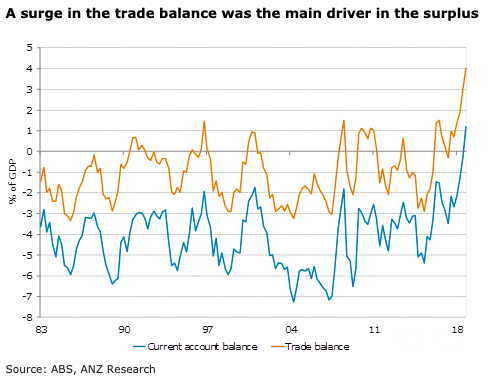
Australia’s current account was in surplus in Q2, improving upon the revised AUD1.1bn (previously AUD2.9bn) deficit in Q1. The trade balance increasing to AUD19.9bn from AUD14.8bn was the main driver of this surplus. The fall in the income deficit added to the size of this surplus by decreasing from AUD15.5bn to AUD13.9bn this quarter, ANZ Research reported.
Export volumes rose 1.4 percent q/q led by a 2.4 percent increase in resources. Coal was the main driver of resource exports, up 3.7 percent q/q while iron ore exports were only up 0.6 percent q/q. Meanwhile rural goods fell 4.3 percent q/q, with weakness seen across most rural categories. Non-monetary gold fell 12 percent q/q in Q2 following the 39.2 percent increase in Q1.
Import volumes fell 1.3 percent q/q reflecting declines across most categories. The biggest decline was from consumption goods, which fell 2.9 percent q/q. The decline in consumption goods was driven by household electrical items falling 6.1 percent and car imports declining 10.6 percent for the quarter.
The terms of trade rose by 1.5 percent q/q, reflecting a large rise in export prices (+2.5 percent) and an increase in import prices (1.0 percent).
"We anticipate further solid trade surpluses going forward, but Q3 looks likely to be a little lower given the fall in commodity prices. The net exports contribution to GDP growth was also stronger than the market expected. Given the weakness seen in other parts of the economy, continued strength in trade will be important for GDP going forward," the report further commented.







