


 Trump Administration Reportedly Halts Venezuela Probe Into Delcy Rodriguez
  U.S.-Iran Talks May Take Days as Oil Prices React to Strait of Hormuz Tensions
  Trump Appoints Pam Bondi to White House AI Advisory Committee
  US Plans Kenya Ebola Quarantine Facility Amid Congo Outbreak
  U.S.-China Taiwan Conflict Could Trigger Nuclear Escalation, IISS Warns
  Baltic Drone Incidents Raise NATO Security Concerns
  Zelenskiy Urges Trump for More Patriot Missiles as Russia Intensifies Ballistic Attacks
  DOJ Opens Criminal Investigation Into E. Jean Carroll Over Alleged Perjury
  Israel Says It Killed New Hamas Military Chief in Gaza Strike
  U.S. Reinstates Sanctions on U.N. Expert Francesca Albanese Amid Legal Battle
  U.S. Launches New Strikes on Iran as Trump Signals Peace Deal Uncertainty
  Flavio Bolsonaro Meets Trump, JD Vance, and Marco Rubio Amid Brazil Political Crisis
  Russia Accuses U.S. of Blocking U.N. Visas for Officials Amid Rising Global Tensions
  Canada and Germany Advance Major LNG Supply Partnership
  Biden Sues DOJ to Block Release of Audio From Classified Documents Probe
  Cambodia King Pardons Opposition Leader Kem Sokha After Treason Conviction
  U.S. Sanctions Iran’s Strait of Hormuz Authority as Global Oil Markets Face Turmoil


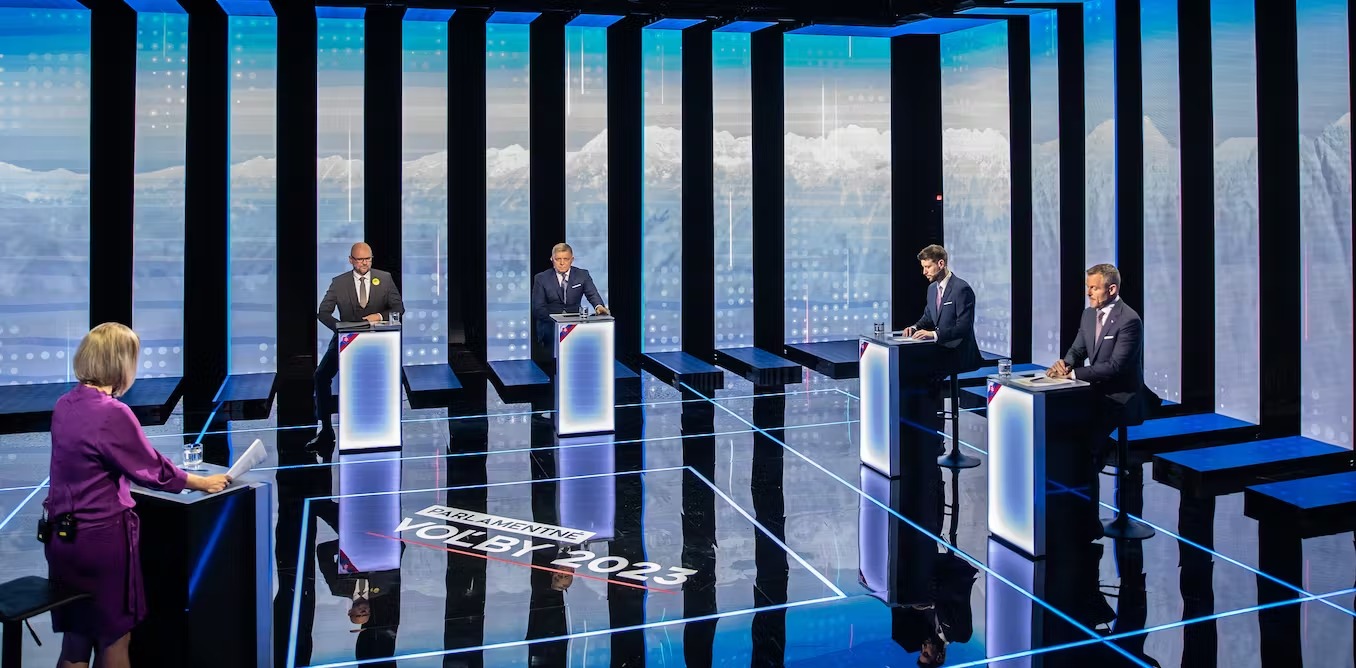

Slovakians head to the polls on September 30 to elect a new parliament. The result will not only have a huge impact on the domestic affairs of this small central European state but also, beyond its borders, on the balance of power in Europe and the war in Ukraine.
After the outbreak of the illegal Russian war in Ukraine, Slovakia was one of the first states to offer support to its neighbour. Slovakians warmly welcomed Ukrainian refugees and its coalition governments have staunchly maintained political, economic and military aid for Kyiv.
But this could very well change after the election. There are 25 political parties fielding candidates and, based on the two latest polls, eight or nine of them are likely to pass the threshold of 5% support required to be allocated seats in the country’s system of proportional representation.
This always results in coalition governments and – like anywhere else with this system – comes with inbuilt insecurity as coalition parties fall out and collapse. Hence Saturday’s election, which comes after only three years of a four-year term in which there have been three different prime ministers.
The party thought likely to win the most votes is Progressive Slovakia (PS), led by Michal Šimečka, a vice-president of the European parliament. Opinion polls suggest that PS, at 18%, has a slight lead over the Smer-SSD (Smer) party (17.7%), led by three-times former prime minister Robert Fico, who is outspoken in his support for Russia and has said he would halt all military aid to Ukraine, should he form a government.
The final opinion poll ahead of Slovakia’s parliamentary election tomorrow is in.
— Visegrád 24 (@visegrad24) September 28, 2023
Surprisingly, it shows the pro-Ukrainian PS party in the lead.
It means that a pro-Russian coalition government between Smer, SNS, Republika & Hlas might be avoided
It will be a tight race though pic.twitter.com/NySdLpQxTZ
The key for both sides is being able to put together a stable enough coalition to form government, and here’s where it gets complicated.
Pro-Kyiv bloc
When it comes to the war in Ukraine, the pro-Kyiv bloc is a coalition of parties with very different ideologies which could find it hard to form a stable government. Two parties that were previously part of pro-Ukraine coalitions, the Democrats, led by former prime minister Eduard Heger, and We Are Family, led by Boris Kollar, are not expected to win enough votes to gain representation in the new parliament.
Other pro-Ukraine parties include the liberal centre-right Freedom and Solidarity (SaS), which is polling at roughly 7.3% according to the latest numbers, and the Christian Democratic Movement (KDH), whose leader, Milan Majersky, recently caused controversy by referring to what he called LGBTQ+ “ideology” as a “scourge” and a “plague”. KDH is polling at 6.1%.
Another pro-Ukrainian party is Ordinary People and Independent Personalities (Olano), a populist centre-right, anti-establishment party which is polling at 9.4%. Olano is led by Igor Matovic, the prime minister from 2020 to 2021 who was forced to resign over his handling of the COVID crisis, when he bought Russia’s Sputnik vaccine against the wishes of his coalition partners.
So, these are the main parties that PS will be looking to deal with should it get the chance to form a coalition – and depending on which pass the threshold to gain seats in the new parliament. But the prospects of PS having the numbers to form a working coalition are far from certain as the campaign goes into its final day.
Anti-Ukraine bloc
Reflecting the growing sentiment among the Slovak population that favours Moscow, and even blames Ukraine for the outbreak of war, is a group of parties led by the centre-left populist party Smer.
Smer and its leader, Fico, supports Slovakia’s membership of the EU and Nato, but is opposed to allowing Ukraine to join either alliance. The party has said it would halt economic and military support to Ukraine. Fico’s party is supported in this position by the Slovak National Party (SNS), a right-wing, Eurosceptic, Russophilic party whose leader, Andrej Danko, is a strong advocate of Moscow. SNS is currently polling at 6%.
To form a government, Smer and SNS would also need to gain support from Republic (5.4%), an extremist, far-right party which blames “Nato’s expansion policy” and Kyiv’s “aggression towards the Russian minority in eastern Ukraine” for the war.
The kingmaker in all this may be Voice - Social Democracy (Hlas), a centre-left, pro-EU, pro-Nato party formed by a group of breakaway MPs from Smer and led by another former prime minister, Peter Pellegrini, who has also said he would halt military aid to Ukraine. But Hlas, which is polling at 15%, is opposed to forming a coalition with extreme right-wing parties.
Danger signs for Kyiv
As it stands, Slovakia may be the first country to change its policy and stop supporting Ukraine. But there are signs other countries could follow suit. Ukraine’s recent row with Poland over grain exports has increased the prospect of a far-right, pro-Russia party winning the elections in Poland in mid-October – which could halt military aid to Ukraine as well.
Meanwhile in the US, the prospect of Donald Trump winning a second term in November 2024 and stopping aid to Ukraine is a distinct possibility.
This “Ukraine fatigue”, especially if it spreads to other countries, could not only protract the war, but ultimately lead to Ukraine’s failure on the battlefield.







