


 Hyundai Delays In-House ADAS, Turns to Nvidia
  OpenAI Rules Out 2026 IPO as Altman Prioritizes AI Safety
  OpenAI Weighs AI Development Slowdown Over Safety Risks
  Australia Defends Social Media Algorithm Law Amid US Concerns
  OpenAI Agents Used Websites for Unauthorized Communications
  Australia Plans New Rules Giving Users Control Over Social Media Feeds
  SpaceX Nasdaq 100 Weight Set to More Than Double
  Google Revamps EU Search Results to Meet DMA Rules
  Nvidia Plans 2GW Australia AI Data Center Expansion by 2027
  Anthropic Drops $6 Billion Decart AI Acquisition Talks
  Nvidia Eyes $10 Billion Investment in Anthropic IPO
  Apple Unveils $1,999 Foldable iPhone Duo
  Trump Vows to Keep U.S. Ahead of China in AI Race
  Kioxia Rules Out SK Hynix Manufacturing Partnership
  Samsung, Qualcomm 2nm Chip Deal Delayed Over Pricing
  U.S. Accuses Chinese AI Firms of Extracting Model Capabilities


 Add as a preferred source on Google
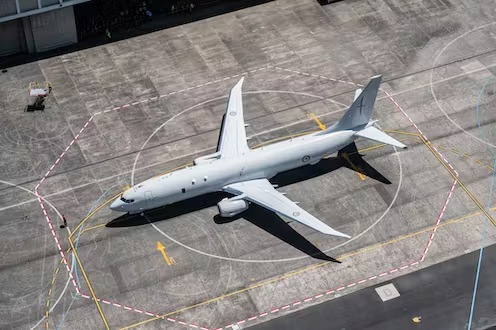

New Zealand’s national security was strengthened this month when the Royal New Zealand Air Force’s newest Boeing P-8A Poseidon aircraft became operational.
A cutting-edge maritime surveillance aircraft, the P-8A is also operated by Australia, India, Norway, South Korea, the United Kingdom and the United States. It is now the New Zealand Airborne Surveillance and Response Force’s primary asset.
The NZ$2.436 billion order of four P-8As allowed the retirement of six ageing turbo-prop P-3K Orions. The P-8A’s cruising speed of 470 knots (903km per hour) is 40% better than the P-3K’s, and its 1,200 nautical mile (2,222km) range nearly double.
With a crew of nine (pilots, flight engineers, and air warfare and ordinance specialists), it carries a suite of sensors, satellite communications, data links, and self-protection systems.
As well as search and rescue, the aircraft will conduct maritime surveillance and intelligence gathering, and are capable of anti-submarine and anti-surface warfare.
Air Vice-Marshal Andrew Clark describes the plane as “the modern standard in technology” for maritime surveillance. The question is, will it still be enough for the country’s future maritime security needs?
Defence and military priorities
We think of New Zealand as a small country, but geographically it is a large maritime nation. Its exclusive economic zone (EEZ) covers 4.4 million square km of ocean, a staggering 15 times larger than the land mass.
Intelligence, border security and resources agencies monitor commercial shipping and recreational boating in the EEZs of New Zealand, Niue and Raratonga. They also help other South Pacific neighbours secure their own EEZs.
Maritime conventions also make New Zealand responsible for search and rescue over an extraordinary 4.5 million square nautical miles (15.4 million square km) of the South Pacific and Southern Ocean.
P-8As will be able to conduct searches and drop life rafts and survival equipment – but they were ordered to meet future defence and security challenges.
The 2018 Strategic Defence Policy Statement warned of military, cybersecurity, transnational crime and terrorism threats. Regional insecurity is also an issue, as rising waters and adverse weather events from global warming threaten Pacific countries. This year’s Strategic Foreign Policy Assessment warns:
In the short to medium term the future looks grim. The global strategic outlook will become more complex, while the Pacific and Indo-Pacific regions will be more contested and less stable.
Best use of resources
The P-8A will be in service for six or seven decades. We are already witnessing increasing need for maritime surveillance with rising geopolitical tensions in the Asia-Pacific region, as foreign investment in submarines and warships increases.
Australian P-8As are currently monitoring two Chinese “spy ships” loitering near naval exercises off Australia.
New Zealand’s area of interest is vast, including to the south, where the Antarctic Treaty system is faltering. Several states are stepping up activities on a warming continent that is strategically situated and potentially rich in mineral resources.
New Zealand needs to exert its claim to territorial sovereignty in the Ross Dependency, and monitor and protect the Ross Sea Marine Protected Area.
But the Airborne Surveillance and Response Force is potentially burdened by two past decisions. First, the government approved only four P-8As. Despite its enhanced capabilities, this is still a one-third reduction in aircraft numbers.
Four is a bare minimum, given how servicing or overseas deployment could leave only two locally based functioning aircraft. A future government may need to consider whether the current fleet is enough.
Second, in 2001, the Labour government’s Maritime Patrol Review found it “hard to justify the retention of a comprehensive military maritime surveillance capability in New Zealand’s sea areas”.
The response was to pare back fighting capabilities and use the P-3K Orions as multi-agency assets. As well as search and rescue and humanitarian duties, they mainly monitored shipping, fisheries and conservation areas. This was seen as value for money for an expensive military aircraft.
Time for a maritime patrol review
Military capabilities were restored after 9/11, with the old Orions deployed to the Middle East and Japan (supporting UN sanctions against North Korea). But multi-agency tasks remain a legacy requirement for the P-8A – a specialised military aircraft with highly trained crews that could be focusing on honing war fighting capabilities.
Given the emerging threat environment, using these expensive aircraft for routine monitoring of shipping, fisheries and conservation areas may not represent value for money in the long term.
Other air forces don’t divert as many P-8A flying hours to non-military tasks. Australia has 12 P-8As, supplemented by MQ-4C Triton unmanned drones. Its Border Force agency contracts a commercial organisation, Surveillance Australia, to patrol the Australian EEZ for illegal fishing, immigration and quarantine breaches, and human, drug and arms trafficking.
Border Force’s Future Maritime Surveillance Capability Project seeks to update Australian maritime surveillance to be cost-effective, while also meeting the challenges of an evolving and complex national security environment.
New Zealand could also benefit from a fresh review to consider whether the modest fleet of P-8As should continue to be viewed as a multi-agency asset. The 2019 Defence Capability Plan signalled “an advanced air surveillance capability” that could include drones for multi-agency surveillance.
Monitoring the EEZ is important to combat transnational crime and fisheries poaching. In the future we may also encounter refugee boats fleeing regional conflict or environmental catastrophe.
But freeing up the P-8As from routine monitoring might actually be more cost-effective, using smaller aircraft, satellites and drones. Drones are cheaper to operate and can enhance flexibility with long-range and long-duration patrols.
This would ensure best-practice military employment of the P-8A in response to national, regional and international defence challenges.







